Ocean Engineering
About
Ocean engineering is a multidisciplinary field aimed at solving engineering problems associated with working in the ocean environment and wisely exploring and harnessing the ocean's resources.
Ocean engineers design, build, operate and maintain ships, offshore structures and a variety of ocean technologies including aircraft carriers, submarines, sailboats, tankers, tugboats, yachts, oil rigs, underwater robots and acoustic sonar.
Ocean engineers study the oceans to determine the effects of waves, currents and the salt water environment on ships and other marine vehicles and structures and develop methods and materials to withstand wave forces and protect against corrosion. Ocean engineers are also involved in development and use of manned and remotely operated sub-surface vehicles for deep-sea exploration and resource recovery. An ocean engineer, Dr. Robert Ballard, located the wreckage of the Titanic.
Ocean Engineering at FAU
The Ocean Engineering program at FAU is accredited by the Engineering Accreditation Commission of ABET. It was introduced in the Fall of 1965 as the nation's first such undergraduate degree program. The program of study leading to a bachelor of science degree in ocean engineering reflects the breadth of the profession. Students complete coursework in science and engineering, including acoustics, hydrodynamics, material science and control. Because of the tremendous impact engineers have on society, the curriculum also requires students to pursue studies in the social sciences and the humanities.
Ocean Engineering Undergraduate Degree Program Information
- Admission Requirements
- Degree Requirements & Certificate Programs
- Sample 4-Year Program
- Common Course Syllabi
- Undergraduate Capstone Senior Design
-
IFP Check Lists and Flight Plans for a Bachelor of Science in Ocean Engineering (BSOE)
- MAC1105 (College Algebra)
- MAC1140 (Pre-Calculus Algebra)
- MAC2311 (Calculus with Analytic Geometry 1)
- Mission, Objectives & Educational Outcomes
- Enrollment and Graduation Data
- 2017-2020 Undergraduate Student Data
- 2016-2017 Undergraduate Student Data
- 2015-2016 Undergraduate Student Data
- 2014-2015 Undergraduate Student Data / College Fact Book
- 2013-2014 Undergraduate Student Data / College Fact Book
- 2012-2013 Undergraduate Student Data / College Fact Book
- 2011-2012 Undergraduate Student Data / College Fact Book
- ABET Related Forms (pdf)
- Continuous Improvement Plan (pdf)
- Student Learning Outcomes Assessment (pdf)
Admission Requirements
To be eligible for admission to the Department of Ocean and Mechanical Engineering, ocean engineering program, an applicant must satisfy the following criteria:
- Meet all the freshmen or transfer admission requirements of the University.
- Meet all Pre-Professional Program requirements.
- Transfer students who have an A.A. degree are expected to have completed the following course requirements (deficiencies may be taken at FAU); see the Degree Requirements section of the Undergraduate Catalog for the required minimum grades.
| Subject | Min. No. of Credits |
|---|---|
| English Composition* | 6 |
| Social Science | 6 |
| Humanities | 6 |
| Calculus (complete three course sequence)* | 12 |
| General Physics with Calculus (complete sequence with Lab) | 8 |
| Differential Equations* | 3 |
| General Physics with Labs | 8 |
| General Chemistry with Lab* | 4 |
| Fundamentals of Engineering* | 3 |
| Engineering Graphics* | 3 |
| C for Engineers* | 3 |
| Electives | 6 |
| TOTAL | 60 |
NOTE: Electives may include a course in health, speech, additional humanities or an additional social science. Consult an advisor for assistance in selecting the appropriate course(s).
* A grade of "C" or better in all courses indicated above. Repeating more than two courses in the Calculus and Physics with Calculus sequences may result in denial of admission.
Degree Requirements and Certificate Programs
Graduation Requirements
- Students who enter Florida Atlantic University as freshmen must meet all baccalaureate degree requirements of the University, including the Intellectual Foundations Program requirements. Students who transfer to FAU with 30 or more accepted credits must meet all baccalaureate degree requirements of the University, including the General Education and Gordon Rule requirements.
- Students must maintain an overall 2.0 or better grade point average in all courses. A grade of "C" or better must be received in all engineering, mathematics, chemistry and physics courses required for the degree. A grade of "C" or better means a grade of "C" or "C+" and excludes a grade of "C?". Ocean Engineering students may not elect the pass/fail option for any required engineering course.
- A subsequent course may not be taken if a required grade of "C" or better is not earned in the prerequisite course. With appropriate justification, a prerequisite waiver may be granted by the Ocean Engineering petitions committee. Prerequisite and co-requisite courses must be taken in the proper sequence.
Graduation Requirements for Transfer Students
- Meet all baccalaureate degree requirements specified by the university.
- Meeting the ocean engineering technical course requirements for mathematics, science, natural science, engineering core and technical electives listed in the course curriculum. These add up to a total of 109 credit-hours.
- Satisfy the curriculum requirements. Note: Since the curriculum is subject to revision, students should check with their Department of Ocean and Mechanical Engineering advisor for the latest requirements.
- Maintain a 2.0 or better combined grade point average for all FAU courses.
The total number of credit hours required for graduation is 127.
Note: Students must satisfy the curriculum requirements; however, since the curriculum is subject to revision, students should check with a program advisor for the latest requirements. Students may not deviate from either the courses defined or the sequence of courses defined for the Ocean Engineering curriculum. In exceptional cases, deviations may be approved in advance by petition to the Ocean Engineering petitions committee. Courses taken in violation of this policy cannot be counted toward the Bachelor of Science in Ocean Engineering degree.
Undergraduate Certificate Programs
- Naval Architecture
- Underwater Acoustics
- Marine Materials and Offshore Engineering
Common Course Syllabi
Required Undergraduate Ocean Engineering Courses
The following is a listing of all common course syllabi for required courses in the Ocean Engineering curriculum. Each syllabus provides guidelines for course content, but may be subject to limited modification by the individual instructor.
The following files are in pdf format:
- EGM 4045 Electro-Mechanical Devices
- EGN 3311 Statics
- EGN 3321 Dynamics
- EGN 3331 Strength of Materials
- EGN 3343 Engineering Thermodynamics
- EGN 3365 Engineering Materials I
- EGN 4323 Vibration Synthesis and Analysis
- EGN 4432 Dynamic Systems
- EGN 4670C Innovative Sensing and Actuation Technologies
- EOC 2801 Fabrications of Ocean Engineering Systems
- EOC 3008 Intro to Oceanography
- EOC 3123 Ocean Engineering Fluid Mechanics
- EOC 3130L Ocean Engineering Lab
- EOC 3213 Materials I - Marine Topics
- EOC 3306 Acoustics for Ocean Engineers
- EOC 3410C Structural Analysis
- EOC 4124 Ship Hydrodynamics
- EOC 4193 Ocean Thermal Systems
- EOC 4201C Marine Materials and Corrosion
- EOC 4307C Underwater Acoustics
- EOC 4412 Ocean Structures
- EOC 4422 Ocean Wave Mechanics
- EOC 4631C Ocean Engineering Data Analysis
- EOC 4804 Ocean Engineering Systems Control and Design
- EOC 4804L Ocean Engineering Systems Control and Design Project
Mission, Objectives and Educational Outcomes
Ocean Engineering Program Mission Statement
The Ocean Engineering Program's mission is to provide an outstanding ocean engineering program for learning and research and to prepare individuals to meet national and international engineering challenges in the ocean environment. The goal of the Ocean Engineering Program is to develop and offer a comprehensive and broad curriculum in science and engineering that prepares a student, upon graduation, to effectively perform engineering tasks in the ocean environment or to successfully pursue higher studies and research in engineering.
Ocean Engineering Program Educational Objectives
Graduates of the ocean engineering baccalaureate program at the Florida Atlantic University, within a few years after graduation, will:
- Demonstrate an ability to carry out engineering tasks in the multi-disciplinary field of ocean engineering.
- Make meaningful contributions in terms of design, development and integration of engineering systems, particularly for applications in the ocean environment.
- Pursue further study for the graduate degree and/or participate in professional societies.
- Develop and exhibit leadership qualities in their engineering work.
- Understand various complexities and issues of the contemporary society and make professional contributions in the larger and long-term interest of the society.
Educational Outcomes for Student Performance
The program will meet the above objectives by establishing the following educational outcomes for student performance. At the time of graduation, the students will attain the following:
- An ability to identify, formulate, and solve complex engineering problems by applying principles of engineering, science, and mathematics.
- An ability to apply engineering design to produce solutions that meet specified needs with consideration of public health, safety, and welfare, as well as global, cultural, social, environmental, and economic factors.
- An ability to communicate effectively with a range of audiences.
- An ability to recognize ethical and professional responsibilities in engineering situations and make informed judgments, which must consider the impact of engineering solutions in global, economic, environmental, and societal contexts.
- An ability to function effectively on a team whose members together provide leadership, create a collaborative and inclusive environment, establish goals, plan tasks, and meet objectives.
- An ability to develop and conduct appropriate experimentation, analyze and interpret data, and use engineering judgment to draw conclusions.
- An ability to acquire and apply new knowledge as needed, using appropriate learning strategies.
- An ability to understand, consider, apply, and test engineering standards and codes.
Undergraduate Capstone Senior Design
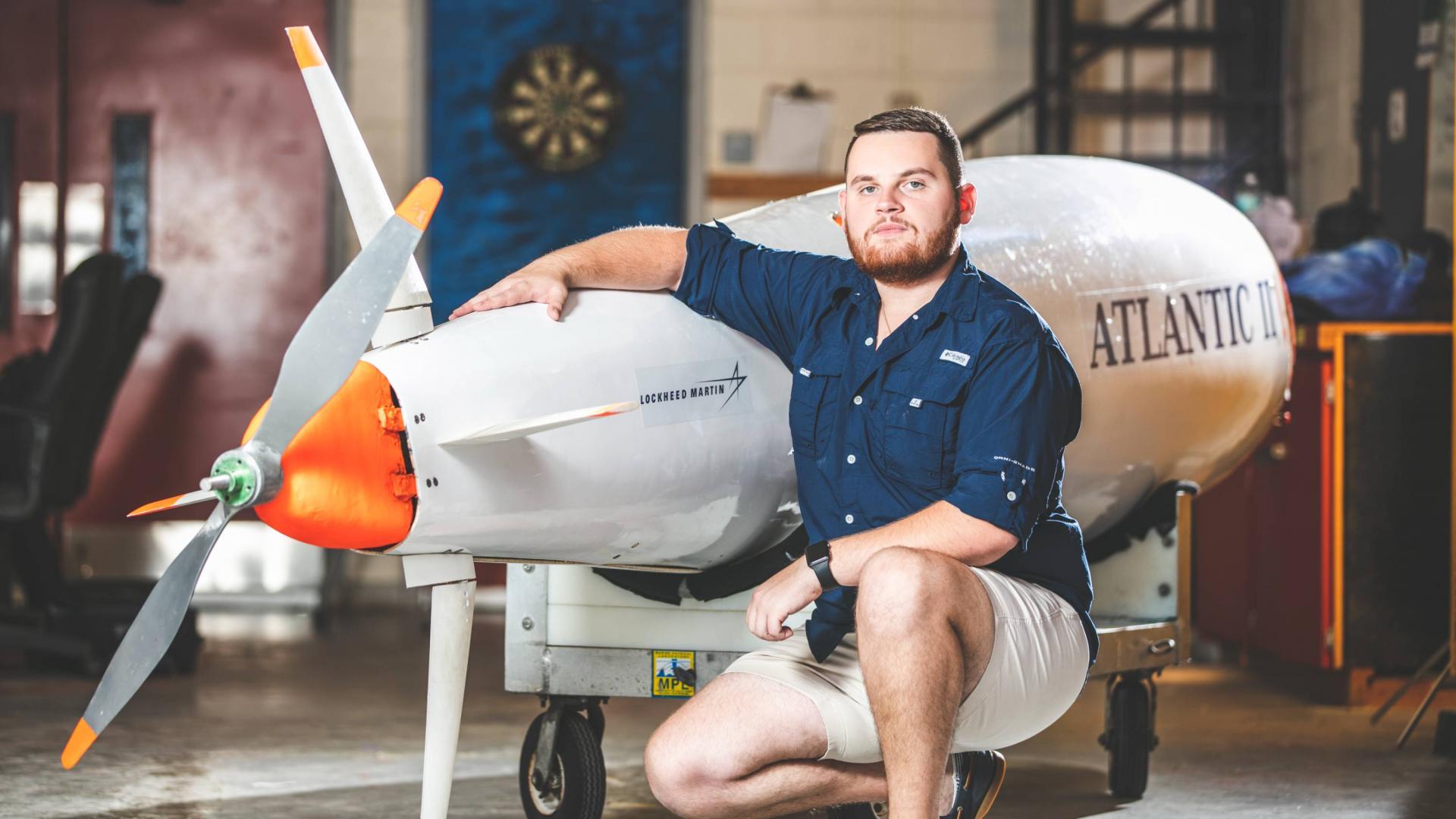
The senior year of the undergraduate program includes a two semester Capstone Senior Design sequence where the students work in teams to design, build and test selected ocean engineering projects.
To help students become aware of external engineering issues and current trends in ocean engineering, we invite people who hold or have held high level positions in ocean engineering to offer formal lectures to senior design students and informally meet with them. The range and experience of the people selected are broad and representative of a wide range of disciplines and backgrounds, governmental and industry related, military and environmental, and national and international.
Leadership Skills
To foster leadership qualities and understanding of management senior projects are conducted in the following sequence. First, lectures are given in: project management, planning and team work; engineering management; motivation, behavior and communication; presentation skills; businesses; managerial accounting; and financial accounting. Second, the design class is divided into teams that work on components of a larger design. As such, the students must develop and demonstrate a high level of inter and intra team coordination and communication. Finally, each team has a designated rotating team leader position. The team leader must not only motivate the other students, but plan activities, and prepare weekly reports. The position rotates so that all students have an opportunity to participate in the position.
Societal Awareness
The weekly guest speaker seminars encourage participants to bring awareness to a host of issues in contemporary society. In addition, the design projects students undertake reflect current and relevant issues in society. As part of the project, the students are required to research the broad concepts of the design topic and the logistics and at-sea operational complexities it entails. Thus, the project not only exposes the students to the challenge of engineering an ocean system, but also familiarizes them with the overall societal relevance of the project and the general engineering complexities associated with at-sea operations and wise utilization of the ocean for the benefit of society.
Ethics
One of the aims of the senior design sequence is to instill an understanding of ethics. To this end, several lectures on ethics are given that teach the four fundamental principles and seven fundamental cannons in the ethics code endorsed by ABET. The series of lectures consist of an entry exam, presentations, and cases studies. The exam is used to assess and to demonstrate to students their level of understanding and need to study ethics. Some of the major focus areas are 1) ethics and the engineering profession, 2) legal and ethical domains, and 3) solving ethical conflicts.
MS with Major in Ocean Engineering
The Department of Ocean and Mechanical Engineering offers an extensive Master of Science degree program in Ocean Engineering with the aim of preparing individuals for engineering challenges to working in the ocean environment.
Specialization in specific Ocean Engineering programs is offered through in-depth studies in the areas of Acoustics, Signal processing, Materials and Corrosion, Marine structures, Marine Hydrodynamics and Autonomous Underwater Vehicles.
- MSOE Thesis, Non-Thesis and Non-Thesis/Business Minor
- Admission Requirements
- Core Course Requirements
- Transfer Credits
- Course Load: All students choosing the MS thesis option and receiving financial assistance must be full-time students. This requires that they are registered for a minimum of 9 credits in the fall semester, 9 credits in the spring semester, and 6 credits for the summer semester. All international students must be registered as full-time students. A maximum of 12 credits may be taken in a semester. In the graduation semester the student may be allowed to take one credit.
- Supervisory Committee
- Plan of Study
- Fast Track Program
- Thesis Work and Progress Reviews
- Degree Requirements
- Unsatisfactory Performance
- MS Program Checklist (pdf)
MSOE Admission Requirements
Specific admission requirements for ocean engineering are more stringent than the general FAU graduate admissions requirements. A candidate for the master's degree program in ocean engineering must satisfy the following entry requirements:
- A baccalaureate degree in engineering, science or mathematics.
- A 3.0 (on a 4.0 scale) GPA or better in the last 60 credits of undergraduate work.
- A Graduate Record Examination (GRE) score will not be required for admission to the Master's degree program in Ocean Engineering.
- Must demonstrate proficiency in both written and spoken English. Students from non English-speaking countries are required to take the Test of English as a Foreign Language (TOEFL) and achieve a score of at least 550 (paper-based) or 213 (computer-based) or 79(IBT), or take the International English Language Testing System (IELTS) and achieve a score of least 6.0.
- All students will have a thesis or advisory committee during their studies. For thesis students their advisor is the chair of the advisory committee. A thesis or advisory committee must be formed before the plan of study can be filed. Students who enter the program without an assistantship will be assigned a mentor by the chair of the graduate committee. Students without an advisor are required to visit at least three faculty members during their first semester requesting to form an advisory committee. A report on the outcome of the faculty visits must be filed with the campus graduate coordinator.
- Adherence to the policies and regulations and the graduate admission requirements of the University as outlined in the University catalog.
- Conditional admission may be permitted if the above requirements are not met.
MSOE Program Options
MS Thesis Option
The MS thesis option requires a minimum of 30 credits, including a minimum of 6 thesis credits. At least 15 of the credits must be taken from the ocean engineering core course list. In addition, 9 credits will be selected in consultation with the student's advisor. At least 15 of the 30 credits must be at or above the 6000 level. No 4000 level courses are allowed towards the degree. Students electing the thesis option will be required to complete the thesis program, which includes successful defense and completion of the thesis.
MS Non-Thesis Option
This option requires a minimum of 30 credits*. At least 15 of the credits must be taken from the ocean engineering core course list. In addition, 15 credits* will be selected in consultation with the student's advisor. No thesis credits may be counted toward this degree. At least half of the credits must be at or above the 6000-level. No 4000-level courses are allowed towards the degree.
MSOE Non-Thesis Option with a Minor in Business
This program leads to a Master of Science in Ocean Engineering with a Minor in Business Administration. It requires a total of 36 credits. At least 15 of the credits must be taken from the ocean engineering core course list. In addition, 6 credits relating to the student's area of specialization in ocean engineering must be selected and 15 credits must be selected from the College of Business approved course list outlined under the Minor in Business heading in the university catalog. At least half of the credits must be at or above the 6000-level. No 4000-level courses are allowed towards the degree.
* Effective for students admitted to the program in Fall 2019 or later.
MSOE Core Course Requirements
All MS graduate students, regardless of option or specialty, must complete the following core courses or must offer a satisfactory substitute course of similar content from another university or an appropriate substitute consistent with the student's specialty for approval by the supervisory committee via a departmental petition:
- Mathematical Methods in Ocean Engineering I* (EOC 5172)
- Engineering Data Analysis (EOC 6635)
- Physical Aspects of Oceanography (OCP 6050)
In addition, two of the following five courses must be taken:
- Advanced Mechanics of Materials** (EOC 6533)
- Mathematical Methods in Ocean Engineering II* (EOC 6174)
- Advanced Hydrodynamics I (EOC 6185)
- Corrosion I (EOC 6216C)
- Engineering Principles of Acoustics (EOC 6317C)
- Special Topics (EOC 6934)
* Students with an advanced mathematics competency may obtain exemption upon entrance to the program for Mathematical Methods in Ocean Engineering I (EOC 5172) and/or Mathematical Methods in Ocean Engineering II (EOC 6174). These students must demonstrate to their advisor, using course descriptions, that the equivalent of five to six courses beyond calculus, including areas such as differential equations, advanced calculus, matrix theory, complex analysis, and probability and statistics have been taken. Approval by the graduate programs committee is also required.
** May be substituted with Theory of Elasticity (EOC 6934).
MS Transfer Credits
A maximum of 12 credits of graduate-level work earned at FAU as an undergraduate or while in non-degree status at FAU and a maximum of 6 credits earned at another recognized institution prior to admission to the ocean or mechanical engineering graduate program may be transferred to a student's MS degree program subject to the following restrictions:
- The student must present a transcript identifying the course, in which the student has earned a grade of "B" or better, along with a catalog/course description.
- The course must not have been counted toward any other graduate or undergraduate degree awarded or to be awarded to the student. Exceptions exist in the BSOE to MS degree program and the BSME to MS degree program where up to 12 credits may be counted towards both the BS and MS degrees.
- The student's advisor and the ocean and mechanical engineering graduate program coordinator, who may seek the advice of other faculty if needed, will decide whether to accept or reject the course credit.
- No credit earned ten or more years before the degree is awarded may be counted toward a graduate degree.
MS Supervisory Committee
All MS graduate students will be assigned an academic advisor who will assist the student in planning a course schedule for the program and will also approve all course selections, schedules, and schedule changes. By the end of the first semester or at the completion of 9 credits, the student, in consultation with the academic advisor, should make the following selections:
- A particular program-emphasis option. If selecting a thesis program then:
- Chair of the supervisory committee.
- At least two other members for the supervisory committee.
The chair of the supervisory committee, who is normally the student's advisor, and at least two of the other members must be chosen from the ocean and mechanical engineering faculty. Members from outside the department may be chosen for the supervisory committee with the permission of the department chair. The student should obtain the consent of other members to serve on the supervisory committee. Having obtained this permission, the names of the committee members should be submitted to the department chair. The committee acts as a unit to guide the student's degree program.
Plan of Study for a Master's Degree
Students choosing the thesis option as part of the MS degree program must, as soon as practical after the selection of a supervisory committee, complete a formal Plan of Study which will include all course and thesis work that the student expects to complete for the MS degree. The Plan of Study must be submitted no later than the end of the second semester. Upon approval of the plan, the student will be admitted to candidacy for the MS Degree. The student is required to defend his/her thesis proposal before the end of the third semester.
For students electing the nonthesis option, the Plan of Study must still be completed and submitted to the Graduate College. For both the thesis and nonthesis track, it is required that the admission to candidacy form be completed and submitted at least one semester prior to the semester in which the student expects to graduate.
*Plans of Study are submitted electronically for approval using the MyPOS System.
MS Fast Track Program
The Department of Ocean and Mechanical Engineering offers accelerated program options for the Master of Science with major in Ocean Engineering (with thesis) and the Master of Science with major in Mechanical Engineering (with thesis) for qualified students who will be supported under research assistantships. The accelerated programs allow students to complete their MS degree in 12 months.
The objective of these options is to provide an opportunity for students to earn their master's degree in one year, which translates into a significant reduction in both time and expense, thus allowing the student to enter the workforce sooner, while minimizing the financial impact of pursuing an MS degree. In order to achieve this goal, the program of study and thesis work must be well defined prior to the student starting the program of study. In addition to the normal requirements, students with an engineering core GPA of 3.5 or better, in conjunction with their prospective graduate studies academic advisor, are invited to submit a letter of intent to the graduate committee for consideration to be admitted into this program. The letter of intent should include an outline of the project and milestones to be reached by the end of each semester. Students admitted into the accelerated option are allowed to take a maximum of 12 credits per semester.
MS Program Thesis Work and Progress Reviews
For those students who elect the MS thesis option, the first step, to be completed by the end of the third semester of full-time enrollment, is the submission of a written thesis proposal to the supervisory committee. This proposal must be approved by the supervisory committee before the student begins extensive work in the selected research area. In the proposal defense, the student presents and defends, as required, the plan research. Each semester after the proposal defense the supervisory committee will review the student's progress.
If at any time the progress in the student's research is found to be unsatisfactory, the supervisory committee will report to the department chair, inform the student in writing as to the nature of the difficulties, and record the committee's opinion in the student's file. The student will then be given ample opportunity to improve performance and defend the student's position at a further review meeting held at the end of the semester. If no improvement has been demonstrated, the student's future program, including the continuation of stipend and tuition waiver, will be re-evaluated.
A minimum of two weeks prior to the anticipated thesis defense, the written thesis must be delivered to the department in the format described in a pamphlet titled Requirements and Guidelines for Graduate Theses and Dissertations. Guidelines may also be obtained from the Office of Graduate Admissions and Graduate Studies or from the Department of Ocean Engineering. An announcement stating the thesis topic and time and location of the defense will be provided to all department faculty and to the supervisory committee members one week prior to the scheduled defense. The announcement will also be posted in the department and/or mailed to all ocean and mechanical engineering faculty, staff and students.
MS Degree Requirements
Master's Program Thesis Option Degree Requirements
For candidates to be awarded the degree of Master of Science with major in Ocean Engineering or the degree of Master of Science with major in Mechanical Engineering they must have:
- Complied with University graduate policies and regulations.
- Satisfied the University's graduate degree requirements.
- Satisfactorily completed the appropriate courses of study.
- One semester of EML 5937, Graduate Seminar (0 credits) with a grade of Satisfactory ("S")*.
- And for the thesis option, submitted and defended a thesis based on the student's original work in an area of specialization.
Nonthesis Option or Minor in Business Option Degree Requirements
The degree of Master of Science with major in Ocean Engineering (nonthesis option or minor in business option) or the degree of Master of Science with major in Mechanical Engineering (nonthesis option or minor in business option) will be awarded to the candidate who has completed requirements 1 to 3 above, and, at the time of application for degree, have submitted a portfolio to their advisor consisting of four graduate projects from courses in their program of study. The portfolio will be reviewed by the students supervisory committee.
*Change effective Fall 2019.
MS Program Unsatisfactory Performance
A MS graduate student whose academic performance is deemed unsatisfactory will be denied further registration in the department programs. Unsatisfactory academic performance is defined as failure to maintain a minimum 3.0 GPA in all FAU graduate program courses at the end of the second semester in the program (this would normally be 15 to 18 credits) or after any subsequent semester. Please note that this is more strict than the University requirement. A student who exhibits unsatisfactory performance in the ocean or mechanical engineering graduate program is not precluded to apply to another program in the University. No graduate credit may be earned for courses completed with a "C-", "D+", "D", "D-", "F", or "U" (refer to the Academic Policies and Regulations in the University Catalog), even if grades in other courses bring the average up to a satisfactory level. A student who withdraws from a course after the Drop/Add period may be required to repay any tuition benefits received.
Doctor of Philosophy with Major in Ocean Engineering
The degree of Doctor of Philosophy with major in Ocean Engineering is conferred on a candidate by the University upon completion of comprehensive training and in recognition of the candidate's ability to independently and efficiently pursue research in ocean engineering. The requirements for the degree include the performance of original research, the preparation of a dissertation describing this research, and systematic advanced studies in engineering and the underlying sciences. This section discusses the details of the degree regulations.
- Admission Requirements
- Transfer Credits
- Core Course Requirements
- Options for Program Emphasis
- Course Load
- Supervisory Committee
- Plan of Study and Admission to Candidacy
- Program Requirements
- BS to PhD Direct-Path Program
- General Exam 1
- General Exam 2
- Dissertation and Progress Reviews
- Residency Requirements
- Degree Requirements
- PhD Program Checklist (pdf)
PhD Program
Plan of Study and Admission to Candidacy
Admission to the doctoral program at FAU does not automatically constitute admission to candidacy for the degree.
A Plan of Study for the PhD degree must be submitted to the Graduate College before the end of the second semester of enrollment. Note that students submit their Plans of Study electronically.
The Graduate College will admit a student to candidacy for the Doctor of Philosophy degree after the following conditions have been met:
- Admission to graduate school to work toward the doctoral degree.
- Successful completion of the General Examination I (PhD Qualifying Exam).
- Selection of a dissertation faculty advisor and the formation of a supervisory committee.
- Formulation and submission of a program of study which is approved by the department.
- Recommendation of the supervisory committee and department chairperson.
Note: Students may not enroll for PhD dissertation credits (EOC 7980) until they have been admitted to candidacy.
Following the successful completion of General Examination I, the student must complete and submit the form Admission to Candidacy for the Doctoral Degree (Form 8). General Examination I and submission of admission to candidacy form should be completed at least two semesters before the beginning of the semester in which the degree is to be conferred. A student not admitted to candidacy before the beginning of the fourth academic year of graduate work at the University must petition through the College to the Graduate College for permission to register for additional work.
PhD Program Admission Requirements
Minimum requirements for admission to doctoral studies in ocean engineering are as follows.
- A baccalaureate in engineering or a related field from a recognized institution;
- An average of "B" or better in the last 60 credits of work attempted;
- A Graduate Record Examination (GRE) score. GRE scores more than five years old will not be accepted. The GRE requirement is waived for applicants who have a Master of Science degree from FAU's Ocean and Mechanical Engineering Department;
- Demonstrated proficiency in both written and spoken English. A student from a non-English-speaking country is required to take the test of English as a Foreign Language (TOEFL) and achieve a score of at least 550 (CBT-213, iBT-79), or take the International English Language Testing System (IELTS) and achieve a score of least 6.0.
- Two letters of reference attesting to the student's potential for graduate studies in ocean engineering;
- Approval for admission by the Department of Ocean and Mechanical Engineering. Usually, an applicant admitted will have a strong record of achievement that exceeds the minimum requirements. It is anticipated almost every applicant will already have a master's degree, but it is not an absolute requirement. Approval for admission by the department will be based on an evaluation of the student's record in terms of likelihood of success in the PhD program.
PhD Program Transfer Credits
The doctoral program may accept for transfer 6 credits beyond the baccalaureate degree from other institutions to the student's degree program upon approval by the department and subject to the following restrictions:
- The student must present a transcript identifying the course in which the student has earned a grade of "B" or better, along with a catalog/course description.
- The course must not have been counted toward any other graduate or undergraduate degree awarded or to be awarded to the student.
- The student's advisor and the Ocean and Mechanical Engineering graduate program committee, who may seek the advice of other faculty if needed, will decide whether to accept or reject the course credit.
- Obtaining credit for a non-FAU course does not alter the total number of credits required for graduation.
- No credit earned ten or more years before the degree is awarded may be counted toward a graduate degree.
Additional credits consistent with University policy may be considered for transfer subject to the restrictions above, if approved by the student's advisor.
PhD Program Course Load
Full-time graduate students are those who register for 9 or more credits during the fall and spring semesters and 6 credits during the summer. Students who wish to register for more than 15 credits for any semester must obtain approval, in advance, from the Graduate College. All students receiving financial assistance must satisfy these requirements and all international students must be full-time students. In the graduating semester the student may be allowed to take 1 credit.
PhD Program Core Course Requirements
All graduate students, regardless of option or specialty, must complete the following core courses or must offer a satisfactory substitute course of similar content from another university or an appropriate substitute consistent with the student's specialty preference for approval by the supervisory committee.
- Mathematical Methods in Ocean Engineering I (EOC 5172)
- Engineering Data Analysis (EOC 6635)
- Physical Aspects of Oceanography (OCP 6050)
In addition, two of the following five courses must be taken:
- Advanced Hydrodynamics I (EOC 6185)
- Corrosion I (EOC 6216C)
- Engineering Principles of Acoustics (EOC 6317C)
- Special Topics (EOC 6934)
Ocean Engineering PhD Program Degree Requirements
The degree of Doctor of Philosophy in Ocean Engineering will be conferred on candidates who have fulfilled the following requirements:
- Completed a minimum of 42 credits of course and dissertation work after the MS degree for students transferring 30 credits (72 credits for those admitted to the PhD directly after the BS degree). Of the 42 credits, 18 must be coursework **;
- Of the 18-credit minimum of coursework, at least 12 credits must be from the Ocean and Mechanical Engineering Department. No more than 3 credits of directed independent study or OME Advanced Research (EML 6918) may be used to satisfy the 18-credit minimum;
- A minimum of 24 dissertation credits. No more than 30 dissertation credits may be counted toward the total credit requirement for the PhD degree. Students admitted to the Ph.D. directly after the B.S. degree must take a minimum of 30 dissertation credits **;
- Completion of two semesters of EML 5937, Graduate Seminar (0 credits) with a grade of Satisfactory ("S")*;
- A major program of research and advanced studies in ocean engineering;
- A minimum of 9 credits in advanced mathematics or equivalent beyond the BS degree;
- Successful completion of General Exam I, a written and oral comprehensive examination of coursework;
- Successful completion of General Exam II, a dissertation proposal defense;
- Prior to the defense, the student is required to have published or have accepted for publication, a refereed research paper in a field of study deemed acceptable by the dissertation committee. A journal article is preferred, but a peer reviewed article is also acceptable*;
- Submitted and defended a dissertation based on original research in the student's area of specialization. The supervisory committee, the department chairperson, and the Graduate College must have approved the dissertation;
- Complied with the University's Graduate Policies and Regulations and satisfied the University's Graduate Degree Requirements.
* Changes are effective for students admitted to the program in Fall 2019 or later.
** Changes are effective for students admitted to the program in Spring 2020 or later.
Ocean Engineering PhD Options for Program Emphasis
Students who wish to specialize in specific Ocean Engineering programs may pursue in-depth studies in the areas of marine materials, offshore structures, hydrodynamics and physical oceanography, marine vehicles, acoustics and other special ocean engineering topics. Unless otherwise stated, the Ocean and Mechanical Engineering Department graduate courses are 3 credits each. All programs require a minimum of 9 credits in graduate level mathematics or equivalent.
- Marine Materials, Offshore Structures and Corrosion Option
- Hydrodynamics and Physical Oceanography Option
- Marine Vehicles Option
- Acoustics and Vibrations Option
Marine Materials, Offshore Structures and Corrosion Option
It is suggested that students in the Marine Materials and Corrosion Option take the following courses in addition to the core courses required for all Ocean Engineering PhD students:
- Advanced Fracture and Failure Processes I (EOC 6157)
- Corrosion I (EOC 6216C)
- Corrosion II (EOC 6218C)
- Physical Metallurgy (EOC 6230)
- Special Topics (Theory of Elasticity) (EOC 6934)
Depending on a student's area of thesis research, elective courses may be chosen from, but are not necessarily limited to, the following:
- Advanced Topics in Physical and Theoretical Chemistry (CHM 6581)
- Introduction to Finite Element Methods (EOC 5351)
- Advanced Strength of Materials (EGM 6533)
- Mechanics of Composite Materials (EGM 6562)
- Mechanics of Polymers (EML 6235)
- Fracture Mechanics (EML 6239)
- Signal Processing (EOC 6630)
- Special Topics (Nanostructured Materials) (EOC 6934)
Hydrodynamics and Physical Oceanography Option
It is suggested that students in the Hydrodynamics and Physical Oceanography Option take the following courses in addition to the core courses required for all Ocean Engineering Ph.D. students:
- Advanced Hydrodynamics I (EOC 6185)
- Computational Fluid Dynamics (EML 6726)
- Turbulent Flow (EOC 6190)
Depending on a student's area of specialization, the elective courses may be chosen from the following list together with other courses offered by the Ocean Engineering Department:
- Mathematical Methods in Ocean Engineering 2 (EOC 6174)
- Advanced Ocean Wave Mechanics (EOC 6320)
- Experimental Marine Hydrodynamics (EOC 6506C)
- Hydrodynamic Aspects of Ship Design (EOC 6515)
- Special Topics (Ship Structural Design; Flow Control) (EOC 6934)
Marine Vehicles Option
In addition to the core requirements, recommended courses include:
- Intelligent Underwater Vehicles I (EOC 6663)
- Special Topics (Underwater Vehicle Navigation; Elements of High Speed Marine Vehicles) (EOC 6934)
Other courses, which may be taken, will be determined by the student's area of emphasis.
Acoustics and Vibrations Option
It is recommended that students in the Acoustics and Vibrations Option take the following courses in addition to the core courses required for all Ocean Engineering Ph.D. students:
- Mechanical Vibrations (EML 6223)
- Advanced Hydrodynamics I (EOC 6185)
- Ocean and Seabed Acoustics (EOC 6312)
- Signal Processing (EOC 6630)
- Special Topics (EOC 6934)
Depending on the student's area of specialization, elective courses may be chosen from the courses offered by the Ocean and Mechanical Engineering department as well as from other departments such as Civil Engineering, Computer Engineering, Electrical Engineering, Mathematics, and Physics.
PhD Program Supervisory Committee
In consultation with the student and the advisor, a supervisory committee will be nominated by the Department Chair, approved by the Dean of the College of Engineering and Computer Science, and appointed by the Graduate College.
The supervisory committee shall consist of no fewer than four members selected from the Ocean and Mechanical Engineering faculty. Additional members can be from the Ocean and Mechanical Engineering Department, other departments, other universities, or from industry.
The committee will include at least one person selected from the faculty from outside the discipline of the student's major. If the student elects or is required to select a minor, this member of the supervisory committee shall represent the discipline selected as the minor.
The supervisory committee should be appointed as soon as possible after the student has passed General Examination I and, in general, no later than the end of the second year of equivalent full-time study. Duties of the supervisory committee include:
- To ensure that the student is aware of all regulations governing the degree. It should be noted, however, that this does not absolve the student of the responsibility of making inquiries regarding the regulations and procedures.
- To discuss and approve the proposed course of study, dissertation research project, and the student's plans for its execution.
- To conduct and take part in the General Examination 2. No fewer than four faculty members shall be present for the General Examination II, which must be given on campus.
- To meet following General Examination 2 to review the research progress, the expected results, and make suggestions for completion of the program.
- To meet on campus when the dissertation is completed and conduct the final oral examination to assure that the dissertation is original research and a contribution to knowledge. No fewer than four faculty members shall be present with the candidate for this examination, but required to sign the dissertation. The supervisory committee must approve the dissertation.
- It is the duty of the supervisory committee to review the student's dissertation carefully. Before signing, each committee member must be sure that it is free of grammatical, editorial, or technical errors.
PhD Ocean Engineering Program Requirements
Course Work and Research
The work for the PhD degree must consist of research and advanced studies in Ocean Engineering (OE), and the student who previously obtained a master's degree will be required to complete a minimum of 42 credits of course and dissertation work for the PhD. At least 12 of the credits must be taken from the OE list of courses and all core course requirements must be satisfied. A minimum of 24 credits of doctoral dissertation research will be required. No more than 30 dissertation credits may be counted towards the degree. Students admitted to the Ph.D. directly after the BS degree must take a minimum of 30 dissertation credits*. The remaining credits may be selected from the listing of OE courses, advanced mathematics courses, elective courses, directed independent study (DIS), or dissertation. A minimum of 9 credits of graduate-level mathematics must be satisfied.
See the BS to PhD Direct-Path Program for outstanding students.
* Changes are effective for students admitted to the program in Spring 2020 or later.
Ocean Engineering PhD Program General Exam 1
Students in the Ocean Engineering PhD program are expected to take the General Examination 1 (PhD Qualifying Examination). The primary purpose of General Exam 1 is to evaluate the student's ability, not only to demonstrate a thorough knowledge of ocean engineering course material, but to evaluate original thinking.
General Examination 1 will be in three (3) parts:
Part 1 - A written exam covering three core courses (OCP 6050 Physical Aspects of Oceanography, EOC 6635 Engineering Data Analysis, EOC 5172 Math Methods in OE 1). This will be four hours in duration and will require four problems to be answered.
Part 2 - A written exam covering three elective subjects. This will be three hours in duration and will require one problem from each elective to be answered.
Part 3 - A pre-proposal that consists of an oral presentation and written paper based on several articles selected by a committee (including the advisor). The student will identify knowledge gap(s), do a literature review (with guidance of the advisor). During the presentation, the questions will be limited to those that help demonstrate knowledge important to the research topic/area.
Students may be exempted from taking a written exam in all or some of the Parts (1, 2), based on the following criteria:
- Students with a cumulative GPA >=3.5 on all courses selected for the QE (minimum B+ in each class), will be exempt from Part 1 and Part 2 only. These students will be allowed to take only Part 3.
- Students with a cumulative GPA >= 3.5, but with a grade of B or less on some of the courses that are part of the Qualifying Exam, will be required to take a written examination only for those courses in Parts 1 or Part 2. These students will also take Part 3.
- Students with a cumulative GPA that is less than 3.5 on all courses selected for the QE, will be required to take a written examination in all courses in Part 1, Part 2, as well as Part 3.
A new set of exams will be prepared and questions and problems from previous exams are not available to students. It is expected that the exam on the elective courses will focus on the student's area of specialization.
Grading
An overall grade of 70 percent on part 1 and part 2 of the General Examination 1 and a passing grade in the pre-proposal constitutes successfully completing General Examination 1. If the student fails any of the parts, the student will have one more opportunity to successfully pass the exam. The student must score 70 percent in each subject that is retaken. Alternatively the student may retake the entire exam when it is next offered. General Exam 1 is scheduled immediately after the last day of the final examination period in the fall semester and in the spring semester each year. The preproposal can be defended during the last two months of the semester including the week after the final exams period, if the advisor indicates that the student is ready.
When to Take the Exam
Students who have obtained the MS in ocean engineering, or the MS in mechanical engineering at FAU, will be allowed to take the General Examination 1 at the end of the first semester, if the student has completed the pre-proposal. Otherwise, the General Examination 1 must be taken no later than the end of the second semester of Ph.D. study. Those admitted to the PhD program directly after the BS degree in ocean or mechanical engineering at FAU may take the exam after completing 24 credits of graduate coursework.
PhD Program General Exam 2
At an appropriate point in a student's graduate studies, (normally within 12 months of passing General Exam 1), student must complete the General Exam 2. This is the dissertation proposal defense, in which students defend the choice of a dissertation topic and answer a series of questions on fundamental issues related to the topic. Students must have passed General Exam 1, selected the dissertation topic, formed a supervisory committee and completed a literature survey prior to the dissertation proposal defense.
In General Exam 2, students should be prepared to demonstrate the ability to perform research on a topic approved by the supervisory committee by presenting a comprehensive literature survey combined with a critical analysis of the state-of-the-art in the particular field selected. While this exam will be centered around a particular research area, it will not necessarily be limited to that subject. If unsuccessful in the exam, the student may, at the discretion of the department, either remain in the doctoral program and retake the exam at a later date or withdraw from the program. No more than two attempts are permitted.
PhD Program Dissertation and Progress Reviews
Following successful completion of the dissertation proposal defense (General Exam II), the student is expected to engage in an intensive program of course work and doctoral dissertation based on a major, original research project. During each subsequent semester, the student's supervisory committee will review the progress. If at any time the student's progress in the research is found to be unsatisfactory, the supervisory committee will report to the department chairperson, inform the student in writing as to the nature of the difficulties, and record the committee's opinion in the student's file. The student will then be given ample opportunity to improve performance and defend the student's position at a further review meeting held at the end of the semester. If no improvement has been demonstrated, the student's future program, including the continuation of stipend and tuition waiver, may be reconsidered.
By the beginning of the semester in which the degree is to be conferred, a candidate for the Doctor of Philosophy degree must deliver a draft of the dissertation to the supervisory committee. Not less than two weeks after the submission of the first draft of the dissertation, the candidate is expected to give a seminar covering the results of the research; this seminar will be followed by a dissertation examination by the supervisory committee. The seminar should be given as early as possible, but not later than two months before the degree is to be conferred.
The PhD dissertation final version must be approved by the supervisory committee and department chairperson and submitted to the dean of the College of Engineering and Computer Science at least one week prior to the due date for submission to the FAU Graduate College. The candidate is responsible for allowing sufficient time for members of the supervisory committee to examine the dissertation. The dissertation must be delivered to the department in the format described in a pamphlet titled Graduate Theses and Dissertations Guidelines. The guidelines may be obtained from the Graduate College or from the Department of Ocean and Mechanical Engineering.
Upon receiving approval from the Graduate College and following completion of all other University requirements, the degree will be recommended. Application for the degree must be made one semester before the semester of graduation.
PhD Program Residency Requirements
Candidates must satisfy the minimum residency requirement for the PhD by completing beyond the master's degree either:
- 18 credits in one calendar year, or
- 24 credits in no more than two calendar years on the Dania Beach, SeaTech or Boca Raton campus of FAU. To satisfy University requirements, two semesters must be full-time, consisting of 9 credits in the spring or fall term and 6 credits in the summer term.
Candidates may be permitted to conduct all or part of their research in the field, in government or industrial laboratories, or elsewhere off campus only if adequate staff, dissertation research supervision, and facilities, as determined by the department, are available.
Ocean Engineering PhD Program Degree Requirements
The degree of Doctor of Philosophy in Ocean Engineering will be conferred on candidates who have fulfilled the following requirements:
- Completed a minimum of 42 credits of course and dissertation work after the MS degree for students transferring 30 credits (72 credits for those admitted to the PhD directly after the BS degree). Of the 42 credits, 18 must be coursework**.
- Of the 18-credit minimum of coursework, at least 12 credits must be from the Ocean and Mechanical Engineering Department. No more than 3 credits of directed independent study or OME Advanced Research (EML 6918) may be used to satisfy the 18-credit minimum.
- A minimum of 24 dissertation credits. No more than 30 dissertation credits may be counted toward the total credit requirement for the PhD degree. Students admitted to the Ph.D. directly after the B.S. degree must take a minimum of 30 dissertation credits**.
- Completion of two semesters of EML 5937, Graduate Seminar (0 credits) with a grade of Satisfactory ("S")*.
- A major program of research and advanced studies in ocean engineering.
- A minimum of 9 credits in advanced mathematics or equivalent beyond the BS degree.
- Successful completion of General Exam I, a written and oral comprehensive examination of coursework.
- Successful completion of General Exam II, a dissertation proposal defense.
- Prior to the defense, the student is required to have published or have accepted for publication, a refereed research paper in a field of study deemed acceptable by the dissertation committee. A journal article is preferred, but a peer reviewed article is also acceptable*.
- Submitted and defended a dissertation based on original research in the student's area of specialization. The supervisory committee, the department chairperson, and the Graduate College must have approved the dissertation.
- Complied with the University's Graduate Policies and Regulations and satisfied the University's Graduate Degree Requirements.
*Changes are effective for students admitted to the program in Fall 2019 or later.
** Changes are effective for students admitted to the program in Spring 2020 or later.