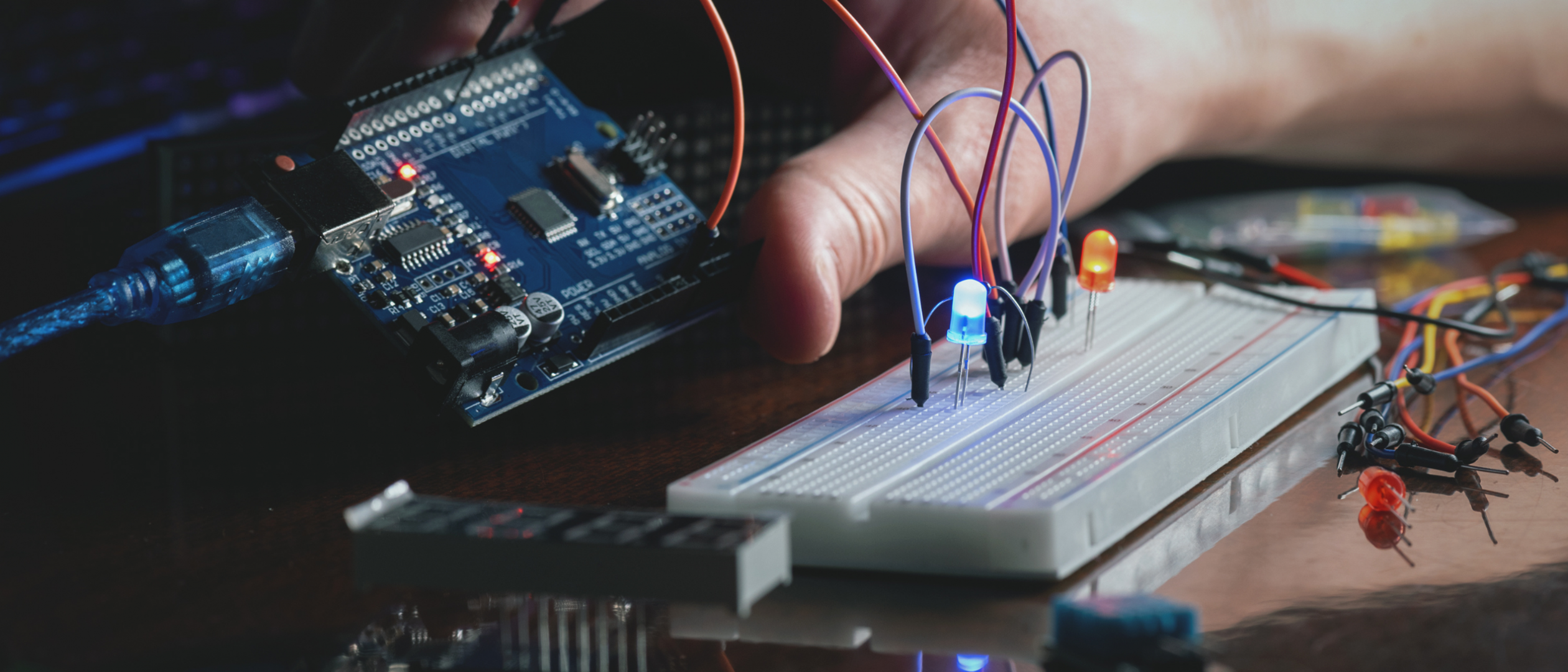
Computer Engineering
What is Computer Engineering About?
Computer engineering focuses on system, software and hardware aspects of computing, and includes programming and software engineering. Students learn about electronics, logic design, computer design and architecture, microprocessors, design automation, operating systems, and software engineering. Computer engineer's career opportunities are limitless and include working in the computer industry or with companies that integrate computers into more complex products.
Computer Engineering Undergraduate Degree Program Information
Additional Resources:
-
IFP Check Lists and Flight Plans for a Bachelor of Science in Computer Engineering (BSCE)
- MAC1105 (College Algebra)
- MAC1140 (Pre-Calculus Algebra)
- MAC2311 (Calculus with Analytic Geometry 1)
- Student Learning Outcomes Assessment
- Course Syllabi
Admission Requirements
All students must meet the minimum admission requirements of the University. Please refer to the Admissions section of the University catalog for detailed information.
All students must meet the preprofessional requirements listed in the University Catalog in order to be accepted into the Computer Engineering program.
The department accepts freshmen and transfer students. Students should refer to the general statements on admission to the College of Engineering and Computer Science and to the University requirements for freshmen and for transfer students.
Prerequisite Coursework for Transfer Students
Students transferring to Florida Atlantic University must complete both lower-division requirements (including the requirements of the Intellectual Foundations Program) and requirements for the college and major. Lower-division requirements may be completed through the A.A. degree from any Florida public college, university or community college or through equivalent coursework at another regionally accredited institution. Before transferring and to ensure timely progress toward the baccalaureate degree, students must also complete the prerequisite courses for their major as outlined in the Transition Guides and below.
All courses not approved by the Florida Statewide Course Numbering System that will be used to satisfy requirements will be evaluated individually on the basis of content and will require a catalog course description and a copy of the syllabus for assessment.
Admission Requirements for a Second BS in Computer Engineering
This program is for those individuals with a degree in another discipline who are seeking a Bachelor of Science in Computer Engineering degree at FAU.
Students seeking a bachelor's degree or graduate degree in another discipline must satisfy all admission requirements of the first bachelor's degree in Computer Engineering at FAU.
The Mission of the Computer Engineering Programs
- To produce graduates with a strong grasp of fundamentals of computer science and computer engineering, knowledge in technical specialty areas and an appreciation of the power of collaborative effort applied to problem solving.
- To offer courses and programs that stimulate innovation and enhance the ability of graduates to achieve high levels of professional development and to succeed in a competitive marketplace.
- To conduct research in selected areas and to integrate research results with teaching activities.
- To provide service to the profession and community and forge strategic alliances with other professions.
Educational Objectives
- Preparation for Practice. Graduates will be prepared for entry-level positions in their discipline and for graduate/professional studies.
- Tools for Creativity. Graduates will experience the creative and design processes and their application to typical engineering situations.
- Societal Awareness. Graduates will receive the breadth of education necessary to integrate practice in their disciplines with the needs and interests of a diverse modern society.
- Leadership Skills. Graduates will be prepared for leadership in their disciplines.
Student Outcomes
Based on the Educational Objectives of the BSCE program, the department has established the following student learning outcomes for the baccalaureate program in Computer Engineering.
Graduates will have:
- An ability to identify, formulate and solve complex engineering problems by applying principles of engineering, science and mathematics.
- An ability to apply engineering design to produce solutions that meet specified needs with consideration of public health, safety and welfare, as well as global, cultural, social, environmental and economic factors.
- An ability to communicate effectively with a range of audiences.
- An ability to recognize ethical and professional responsibilities in engineering situations and make informed judgments, which must consider the impact of engineering solutions in global, economic, environmental and societal contexts.
- An ability to function effectively on a team whose members together provide leadership, create a collaborative and inclusive environment, establish goals, plan tasks and meet objectives.
- An ability to develop and conduct appropriate experimentation, analyze and interpret data and use engineering judgment to draw conclusions.
- An ability to acquire and apply new knowledge as needed, using appropriate learning strategies.
While undergraduate students make some use of University computing facilities, the department has its own facilities that are available for undergraduates and are used for assignments in many courses. A PC-based lab provides students with hands-on experience in logic design, peripheral interfacing and software design for microprocessors. Undergraduates use the department's network of UNIX and PC workstations for coursework in areas such as programming, software development using advanced tools, artificial intelligence, simulation and graphics.
The Bachelor of Science in Computer Engineering program is accredited by the Engineering Accreditation Commission of ABET.
Bachelor of Science in Computer Engineering
Program Summary (Requires 123 credits)
|
Course Title |
Credits |
|---|---|
|
General Education |
24 |
|
Mathematics |
15 |
|
Science |
9 |
|
Common Core |
24 |
|
Computer Science - Computer Engineering Core |
15 |
|
Computer Engineering - Electrical Engineering Core |
18 |
|
Computer Engineering Core |
3 |
|
Semi-Core Group |
6 |
|
Elective |
9 |
|
Subtotal |
123 |
General Education
|
Course Title |
Credits |
|---|---|
|
Foundations of Written Communication |
6 |
|
Foundations of Society and Human Behavior |
6 |
|
Foundations of Global Citizenship |
6 |
|
Foundations of Humanities |
6 |
|
Subtotal |
24 |
Mathematics
|
Course Title |
Course Number |
Credits |
|---|---|---|
|
Calculus with Analytic Geometry 1 |
MAC 2311 |
4 |
|
Calculus with Analytic Geometry 2 |
MAC 2312 |
4 |
|
Calculus with Analytic Geometry 3 |
MAC 2313 |
4 |
|
Engineering Math 1 |
MAP 3305 |
3 |
|
Subtotal |
15 |
Science
|
Course Title |
Course Number |
Credits |
|---|---|---|
|
General Physics for Engineers 1 |
PHY 2048 |
4 |
|
General Physics Lab 1 |
PHY 2048L |
1 |
|
Physics for Engineers 2 |
PHY 2044 |
3 |
|
General Physics Lab 2 |
PHY 2049L |
1 |
|
Subtotal |
9 |
Core Courses
All students must take the following core courses, which total 60 credits.
Common Core
|
Course Title |
Course Number |
Credits |
|---|---|---|
|
Introduction to Data Science and Analytics |
CAP 4773 |
3 |
|
Computer Logic Design |
CDA 3203 |
3 |
|
Computer Architecture |
CDA 4102 |
3 |
|
Foundations of Computing |
COT 2000 |
3 |
|
Programming 1 |
COP 2220 |
3 |
|
Stochastic Models |
EEE 4541 |
3 |
|
RI: Engineering Design 1 |
EGN 4950C |
3 |
|
RI: Engineering Design 2 |
EGN 4952C |
3 |
|
Subtotal |
24 |
Computer Science - Computer Engineering Core
|
Course Title |
Course Number |
Credits |
|---|---|---|
|
Principles of Software Engineering |
CEN 4010 |
3 |
|
Communication Networks |
CNT 4007 |
3 |
|
Programming 2 |
COP 3014 |
3 |
|
Data Structures and Algorithm Analysis |
COP 3530 |
3 |
|
Computer Operating Systems |
COP 4610 |
3 |
|
Subtotal |
15 |
Computer Engineering - Electrical Engineering Core
|
Course Title |
Course Number |
Credits |
|---|---|---|
|
Design of Digital Systems and Lab |
CDA 4240C |
3 |
|
Electronics 1 |
EEE 3300 |
3 |
|
Circuits 1 |
EEL 3111 |
3 |
|
Electronics Laboratory 1 |
EEL 3118L |
3 |
|
Signals and Digital Filter Design |
EEL 3502 |
3 |
|
Fundamentals of Engineering |
EGN 1002 |
3 |
|
Subtotal |
18 |
Computer Engineering Core
|
Course Title |
Course Number |
Credits |
|---|---|---|
|
Intro to Embedded System Design |
CDA 4630 |
3 |
|
Subtotal |
3 |
Semi-Core Courses
All students must take 6 credits from the Semi-Core Group.
Computer Engineering Semi-Core Group
|
Course Title |
Course Number |
Credits |
|---|---|---|
|
Introduction to VLSI Design |
CDA 4210 |
3 |
|
Hardware Security |
CDA 4323 |
3 |
|
Hardware Software Codesign |
CEN 4214 |
3 |
|
Introduction to Internet of Things and Sensor Networks |
CNT 4164 |
3 |
|
Electronics 2 and Lab |
EEE 4361C |
3 |
|
Subtotal |
6 |
Electives
All students must take 9 credits of elective courses. Any 4000-level course offered by the Electrical Engineering and Computer Science department can be used as a Computer Engineering elective. Certain 5000- or 6000-level courses may be taken as Computer Engineering electives. Students must see an advisor for a current list of approved elective courses.
|
Course Title |
Course Number |
Credits |
|---|---|---|
|
Computer Engineering Electives |
See Advisor |
9 |
|
Direct Independent Study |
COT 4900 |
1-3 |
For Directed Independent Study, students must have completed COP 3530, Data Structures and Algorithm Analysis, with a minimum grade of "C" before being eligible to register for directed independent study. Students are permitted to take no more than the equivalent of one course (3 credits) to satisfy degree requirements.
***Please check University Catalog for newest updates.
MS Computer Engineering
Admission Requirements
- Students are expected to have a bachelor’s degree in engineering or a related field. Applicants with a different background are encouraged to apply. Students are expected to have taken calculus 2 and a statistics course, to be proficient in programming, and to be knowledgeable in the topics of microprocessor systems, computer architecture or CAD-based computer design, electronics or VLSI, data structures and algorithm analysis. The admission committee will evaluate the application holistically to determine applicant suitability using several factors such as academic performance, GPA, background and experience. The admission committee may assign remedial courses on a case-by-case basis.
- Submit official transcripts from previous institutions attended. The desirable minimum bachelor GPA is 3.0 (of a 4.0 maximum) in the last 60 credits attempted prior to graduation.
- The GRE is not required for this program.
- International students from non-English-speaking countries must be proficient in written and spoken English as evidenced by a score of at least 500 (paper-based test) or 213 (computer-based test) or 79 (Internet-based test) on the TOEFL or a score of at least 6.0 on the IELTS.
MSCE with or without Thesis - Admission to Candidacy/Online Plan of Study
Students must apply for candidacy as soon as they are eligible. Students should prepare, in a consultation with a graduate advisor, an Online Plan of Study that will include the list of courses for completing their degree requirements. The student's advisor must approve all courses. A student is eligible to apply for candidacy when:
- A minimum of 9 credits as a graduate student have been completed.
- A minimum of 3.0 GPA in all courses attempted as a graduate student has been maintained.
Normally no more than 15 credits of work completed before admission to candidacy will be accepted toward a degree program. Students working toward degrees with thesis options may not register for thesis until their admission to candidacy.
Graduate Courses
Both thesis and non-thesis options require a minimum of 30 credits. Students must take 1 course from Computer Architecture and Design (graduate course prefix CDA), 1 course from Software and Programming (graduate course prefix COP or CEN), and 1 course from Systems and Applications (graduate course prefix CAP, CIS, CNT, or EEL). Please note that courses CEN 5931, CEN 6930 may be counted only with prior approval of the advisor.
In addition, students pursuing non-thesis option will take 7 elective courses and students pursuing thesis option will take 6 thesis credits and 5 elective courses. All students must complete one semester of CGS 5937 Graduate Seminar (0 credits).
The EECS Department offers a rich and diverse selection of elective courses in traditional areas of computer engineering and in the areas of research of the faculty including computer architecture and design, embedded systems, structured VLSI design, design of digital systems, cryptography, computer networks, wireless communications, vehicular networks, IoT and smart systems, parallel and distributed systems, medical information systems, machine learning, artificial intelligence, robotics, and signal processing. Visit the department course schedule for a comprehensive list of elective courses.
Degree Requirements
The Master of Science with Major in Computer Engineering program offers both thesis and non-thesis options. Both options require a minimum of 30 credits.
Students must satisfy all of the University graduate requirements. In addition, the following requirements must be met:
- Must have a GPA of 3.0 (out of 4.0) or better.
- All courses in the degree program must be completed with a grade of "C" or better.
- At least one-half of the credits must be at the 6000 level or above.
- Must complete one semester of CGS 5937 Graduate Seminar.
- Students can take a maximum of 3 credits of independent study.
Transfer Credits
Any transfer credits toward the requirements for a master's degree in Computer Engineering must be approved by the Department, the College and the University. The transfer credits must correspond to equivalent requirements and performance levels expected for the degree. Normally no more than 6 credits of coursework (that have not been applied to a degree) can be transferred from another institution.
PhD Computer Engineering
Admission Requirements
MS to PhD
- Students are expected to have a Master’s degree in engineering, computer science, or a related discipline awarded by a recognized institution. Applicants with a different background are encouraged to apply. Students are expected to have taken calculus 2 and a statistics course, to be proficient in programming, and to be knowledgeable in the topics of microprocessor systems, computer architecture or CAD-based computer design, electronics or VLSI, data structures and algorithm analysis. The admission committee will evaluate the application holistically to determine applicant suitability using several factors such as academic performance, GPA, GRE scores, background and experience. The admission committee may assign remedial courses on a case-by-case basis.
- Submit official transcripts from previous institutions attended. The desirable minimum GPA in previous graduate work is 3.3 (of a 4.0 maximum).
- Submit the Graduate Record Examination (GRE) scores. The GRE requirement is waived for students with a Master’s degree from EECS.
- The applicant must produce two reference letters that address the student's research potential, motivation, relative academic achievement and personality.
- International students from non-English-speaking countries must be proficient in written and spoken English as evidenced by a score of at least 500 (paper-based test) or 213 (computer-based test) or 79 (Internet-based test) on the TOEFL or a score of at least 6.0 on the IELTS.
- Statement of Research Interests
BS to PhD Direct Path program
- Students are expected to have a bachelor’s degree in engineering or a related field. Students are expected to have taken calculus 2 and a statistics course, to be proficient in programming, and to be knowledgeable in the topics of microprocessor systems, computer architecture or CAD-based computer design, electronics or VLSI, data structures and algorithm analysis. The admission committee will evaluate the application holistically to determine applicant suitability using several factors such as academic performance, GPA, GRE scores, background and experience. The admission committee may assign remedial courses on a case-by-case basis.
- Submit official transcripts from previous institutions attended. The desirable minimum bachelor GPA is 3.3 (of a 4.0 maximum) in the last 60 credits attempted prior to graduation.
- Submit the Graduate Record Examination (GRE) scores. The desirable combined score (verbal and quantitative) of the GRE is 310 or better.
- The applicant must produce two reference letters. Where possible these letters should address the student's qualifications for research.
- International students from non-English-speaking countries must be proficient in written and spoken English as evidenced by a score of at least 500 (paper-based test) or 213 (computer-based test) or 79 (Internet-based test) on the TOEFL or a score of at least 6.0 on the IELTS.
- Statement of Research Interests
Students in the MS Program at FAU can apply for the direct path Ph.D. program within the first year of graduate studies. In addition to the requirements stipulated for the BS to PhD program, the students must have a minimum GPA of 3.5 in the graduate program at FAU.
As part of the application to EECS PhD programs, applicants are required to submit a research statement. This crucial document should clearly communicate the applicant’s research background, interests, and potential fit with current research foci of faculty in the department. Applicants are strongly encouraged to go over the department's faculty research and publications before writing their research statement. The research statement must address three main areas:
- The Applicant’s Research Experience and Preparation
Describe the academic and professional experiences that have prepared the applicant for doctoral studies:- Relevant coursework, research training, and applicable professional experience
- Research projects and technical skills
- Publications, presentations, or significant findings
- The Applicant’s Proposed Research Direction
Outline the research areas to be pursued during PhD studies:
- Clearly state research interests
- Explain the importance of this research
- Describe how previous experiences have prepared the applicant for this research
- Faculty Alignment
Identify potential faculty advisors in the EECS department:
- Name two or three faculty members whose research aligns with the applicant’s proposed research direction
- For each faculty member, (i) explain how their work connects to the applicant’s research interests and (ii) discuss how their expertise would benefit the proposed research program
Admission to Candidacy
Students should apply for candidacy as soon as they become eligible. A doctoral student is eligible to apply for candidacy when:
- He/she has passed the qualifying examination.
- A minimum of 3.0 GPA in all courses attempted as a doctoral student has been maintained.
Students may not register for dissertation credits until their admission to candidacy.
Transfer Credits
Any transfer credits (from other institutions) toward the requirements for the PhD degree must be approved by the department, the college, and the university. The transfer credits must correspond to equivalent requirements and performance levels expected for the degree. A maximum of 30 credit-hours can be transferred from a Master's degree. In addition to the credits for a Master's degree, no more than 6 credit-hours of course work can be transferred from another institution.
Qualifying Exam
Note: The Qualifying Exam for the PhD in Computer Science, Computer Engineering or Electrical Engineering is the same except for the course selections (see the application form).
The Computer Engineering (CE) Qualifying Exam is a written exam intended to assess whether a student is ready to conduct research at the doctoral level and is able to publish in international conferences and journals. This exam must be passed for formal admission into the doctoral program. Students seeking the PhD degree are expected to take the exam during the second semester of their doctoral studies, excluding the Summer semester.
The exam addresses the student's knowledge of graduate and undergraduate course material and basic mathematical concepts and engineering methods required for research and professional practice at the doctoral level. The exam consists of six problems (one from each course) related to material covered in recent FAU graduate and undergraduate CE courses, which are prepared by faculty with input from the student and selected by the Graduate Committee. The exam, administered in the Fall and Spring semesters, is given in two 3-hour sessions, each session covering three courses, morning and afternoon, in one day. The student can bring three 2-sided pages of notes and a simple calculator to each session, but no books, computers, or phones. An overall minimum score of 70% or better is required to pass. A student failing the written exam may, upon re-application, take it a second time. Two failures will normally result in the student's dismissal from the PhD program.
Application for the Computer Engineering Qualifying Exam
Students need to fill out and submit an application for the qualifying exam. In filling out the form, the student should list six courses, at most four of which may be at the graduate level and at least two of which must be at the undergraduate level and selected from one of the lists below. Each of the graduate courses selected must satisfy the following requirements: (1) the course is not a DIS course (i.e. BME 6905, COT 6900, COT 6905, EEL 6905), (2) at most 2 graduate courses taught by the same instructor, and (3) the course was offered by the EECS department in the preceding three years. Students can select at most one graduate course outside the EECS department with the approval of the advisor. All other courses must have been offered by the EECS department during the preceding three years but the student may have taken them anywhere or prepared for them on their own. The student will also list a primary area of research and at least one secondary area.
Computer Engineering Courses
- CDA 4102 Computer Architecture
- CDA 4240C Design of Digital Systems
- CNT 4007 Communication Networks
- COP 3530 Data Structures and Algorithm Analysis or COP 3410 Data Structures and Algorithm Analysis with Python
- COP 4610 Computer Operating Systems
- EEE 3300 Electronics 1
Textbook information and QE topics for each undergraduate course are available at /engineering/eecs/pdf/qe-course-topics.pdf.
Degree Requirements
MS to PhD
A minimum of 72 graduate credits is required beyond a bachelor's degree. A master's degree in a related field is considered equivalent to 30 credits. A minimum of 18 credits of coursework is required beyond a master's degree. All courses must be approved by the student's advisor. In addition to meeting the course requirement, a doctoral student must pass the Candidacy Examination, complete the dissertation under the supervision of the student's advisor and dissertation committee and pass the oral dissertation examination. In addition, a written dissertation proposal must be accepted by the dissertation committee at least six months prior to the oral dissertation examination. A doctoral candidate is expected to have at least one research paper published or accepted for publication in a fully refereed conference or journal prior to graduation. The following rules apply to the courses taken beyond the master's degree:
- Of the 18-credit minimum of coursework, a minimum of 12 credits must be in Computer Science and Engineering courses (excluding directed independent study credits) and a minimum of 9 credits of 6000-level courses must be completed.
- A maximum of 3 credits of directed independent study or advanced research may be used to satisfy the minimum of 18 credits. In that case, the subject matter may not overlap the student's dissertation.
- Students must register for a minimum of 24 credits of dissertation.
- Students must have a GPA of 3.0 (out of 4.0 maximum) or better.
- All courses in the degree programs must be completed with a grade of "C" or better.
- Students must complete two semesters of CGS 5937 Graduate Seminar.
BS to PhD
A minimum of 72 graduate credits is required beyond a bachelor's degree. A minimum of 42 credits of graduate coursework is required. All courses must be approved by the student's advisor. In addition to meeting the course requirement, a doctoral student must pass the Candidacy Examination, complete the dissertation under the supervision of the student's advisor and dissertation committee and pass the oral dissertation examination. The Qualifying Examination will normally be taken after the student has completed 24 credits of graduate coursework. In addition, a written dissertation proposal must be accepted by the dissertation committee at least six months prior to the oral dissertation examination. A doctoral candidate is expected to have at least one research paper published or accepted for publication in a fully refereed conference or journal prior to graduation. The following rules apply to the courses:
- Of the 42-credit minimum of coursework, a minimum of 27 credits must be in Computer Science and Engineering courses (excluding directed independent study credits) and a minimum of 18 credits of 6000-level courses must be completed.
- A maximum of 6 credits of directed independent study and/or advanced research graduate courses may be used to satisfy the minimum of 42 credits. In that case, the subject matter may not overlap the student's dissertation.
- Students must register for a minimum of 30 credits of dissertation.
- Students must have a GPA of 3.0 (out of 4.0 maximum) or better.
- All courses in the degree programs must be completed with a grade of "C" or better.
- Students must complete two semesters of CGS 5937 Graduate Seminar.
Dissertation Information
Dissertation Committee
Students are encouraged to interact with faculty members of the department to select a dissertation advisor and research area/topic for their dissertation. After a student has passed the Candidacy Examination, a dissertation committee shall be formed to supervise the student's research work. The committee will consist of at least four faculty members who are familiar with the research area, at least three of whom are regular faculty members of the department. At least one member of the committee is recommended to be from outside the department (could also be from another institution or industry), and this member should have an academic or professional level compatible with the rest of the committee. The committee is chaired by the student's dissertation advisor. The chair of the committee must be a faculty member from the EECS department. Students are expected to work in close cooperation with their dissertation committee and to keep the committee members informed about their progress on a regular basis. The dissertation committee should meet with the student at least once a semester to review the progress of the research work.
Time Limitation
A PhD student who enters the program with a Master's degree has no more than ten years to complete all requirements for the PhD degree.
Dissertation and Oral Defense
The dissertation must be written in the format specified by the Graduate College. A copy of the dissertation must be submitted to the Graduate College for approval of the dissertation format. Dissertations must be defended orally. A dissertation should be submitted to the members of the dissertation committee for their review at least two weeks before the oral defense. After an oral defense, the members of the dissertation committee vote on acceptance or rejection of the dissertation. The committee may also suggest that the student do some additional work so as to make the dissertation acceptable. The decision of the dissertation committee will be reported in the form of satisfactory/ unsatisfactory grade for dissertation credits.