NANOCOMPOSITES AND STRUCTURES LABORATORY
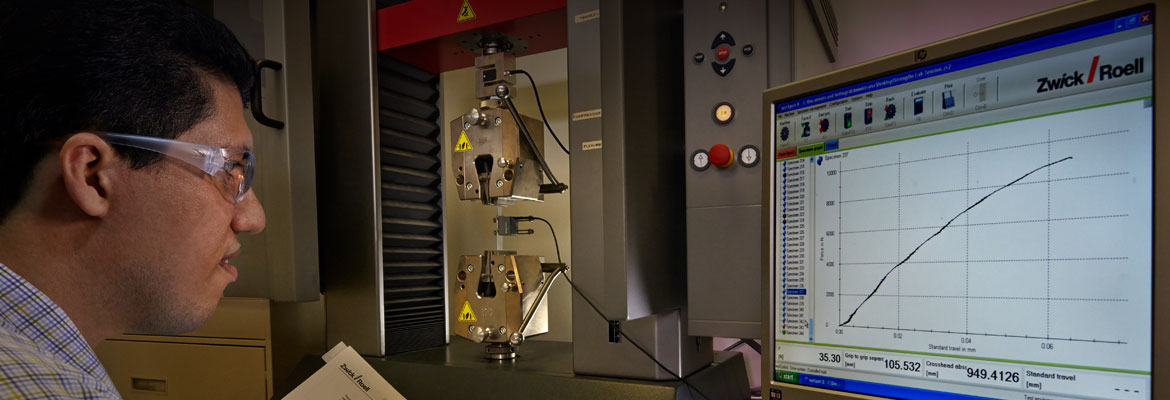
The Nanocomposites and Structures Laboratory in the Florida Atlantic University (FAU) Department of Ocean and Mechanical Engineering (OME) was established in 2005 with funding from FAU, the National Science Foundation (NSF), the Office of Naval Research (ONR) and the Army Research Office (ARO). With all of the latest equipment the laboratory is fully functional for synthesis, characterization, and analysis of nanocomposites and composite structures. The laboratory supports and funds a large number of doctoral, masters, and undergraduate students in fulfilling the research mission of the University. read more

ABOUT
The Nanocomposites and Structures Laboratory research focuses on synthesis, characterization, and analysis of nanocomposites and composite structures.
The labs current research focus areas include:
-
Enhancement of Strength and Stiffness of Nylon 6 Filaments through Carbon Nanotube Reinforcement
A method to fabricate carbon nanotube reinforced Nylon filaments through an extrusion process has been developed. In this process, Nylon 6 and multi-walled carbon nanotubes (MWCNT) are first dry mixed and then extruded in the form of continuous filaments by a single screw extrusion method. Thermogravimetric analysis (TGA) and differential scanning calorimetry (DSC) studies have indicated that there is a moderate increase in Tg without a discernible shift in the melting endotherm. Tensile tests on single filaments have demonstrated that Young’s modulus and strength of the nano-phased filaments have increased by 220% and 164%, respectively with the addition of only 1 wt. % MWCNTs. SEM studies and micromechanics based calculations have shown that the alignment of MWCNTs in the filaments, and high interfacial shear strength between the matrix and the nanotube reinforcement was responsible for such a dramatic improvement in properties. [Applied Physics Letter 88, 083119 _2006].
-
Enhanced Spike Resistance of Armor Composites with Functionalized Silica Nanoparticles
Traditionally shear thickening fluid (STF) reinforced with Kevlar has been used to develop flexible armor. At the core of the STF-Kevlar composites is a mixture of polyethylene glycol (PEG) and silica particles. This mixture is often known as STF and is consisted of approximately 45 wt% PEG and 55 wt% silica. In the current approach, nanoscale silica particles were dispersed directly into a mixture of PEG and ethanol through a sonic cavitation process. Two types of silica nanoparticles were used in the investigation – 30 nm crystalline silica and 7 nm amorphous silica. The admixture was then reinforced with Kevlar fabric to produce flexible armor composites. In the next step, silica particles were functionalized with a silane coupling agent to enhance bonding between silica and PEG. The performance of the resulting armor composites improved significantly. As evidenced by National Institute of Justice (NIJ) spike tests, the energy required for 0-layer penetration (i.e., no penetration) increased two fold, from 12 J-cm2/g to 25 J-cm2/g. The source of this improvement has been traced to the formation of siloxane (Si-O-Si) bonds between silica and PEG, and superior coating of Kevlar filaments with particles. [Journal of Applied Physics 105, 064307 _2009].
-
Resource Characterization and Statistical Modeling of Ocean Current at the Gulf Stream
A statistical ocean current model has been developed based on data collected from the Gulf Stream along the Florida Straits. Due to the random nature of ocean current velocity, the model was described by a Gaussian Probability Density Function (PDF). Like wind speed distribution, the Power Spectral Density (PSD) of ocean current velocity is distributed over a wide range of frequencies but characterized by distinguishable peaks resulting from tidal currents. Accordingly, the total velocity was considered as a sum of the mean velocity and a random component. To account for the tidal effect, a tidal current component was added based on PSD values. In addition, the model was formulated as a function of normalized depth that could be used at any site for resource characterization. For validation, the proposed model was used to predict mean velocity and standard deviation at four different sites along the Gulf Stream. Predicted values were then compared with measured data at those four locations and a good correlation was observed. [Marine Technology Society Journal (MTSJ), Vol. 51, No.1, 2017, pp. 52-63].
Current Research Funding
- Structure-Property Relationship in Organic Matrix Nanocomposites for High Temperature Applications
- Air Force Research Laboratory (AFRL)
- H. Mahfuz (PI) with Leif Carlsson and Andrew Terentis
- 10/01/13 – 09/30/18
- $225,000
- Fatigue Modeling and Life Prediction of Composite Ocean Current Turbine Blades
- Research Laboratory of IHI Corporation, Yokohama, Japan
- H. Mahfuz (PI)
- 10/01/13 – 03/31/18
- $215,213
- In-Situ Micro-Viscosity for Precise Cure Monitoring and Control
- Air Force Research Laboratory (AFRL)
- H. Mahfuz (PI)
- 04/1/17 – 03/31/18
- $50,500
Contact
Hassan Mahfuz, Ph.D.
Lab Director, Associate Dean for Research, and Professor
Nanocomposites and Structures Laboratory
Department of Ocean and Mechanical Engineering
College of Engineering and Computer Science
Florida Atlantic University
777 Glades Rd.
Testing: EW Bldg. 36, Rm. 258
Synthesis & Processing: Bldg. T-11, Rm. 127 & Bldg. 43, Rm. 129
Boca Raton, FL 33431
P. 561.297.3483 • hmahfuz@fau.edu