Mobile Applications to Connect the InstaTemp to Smartphones
Mobile Applications to Connect the InstaTemp to Smartphones
Arc Devices, a member of our I/UCRC CAKE, has developed InstaTemp, which is no-touch thermometer that uses infrared technology to measure body temperature quickly and precisely. InstaTemp and its clinical version InstaTemp MD, which is more precise, were recently approved by the FDA. Once the device is placed roughly an inch from a patient’s forehead, it displays a temperature in 2.5 seconds—coded red, yellow or green, depending on the reading.
TIME magazine included InstaTemp in the 25 Best Inventions of 2016.
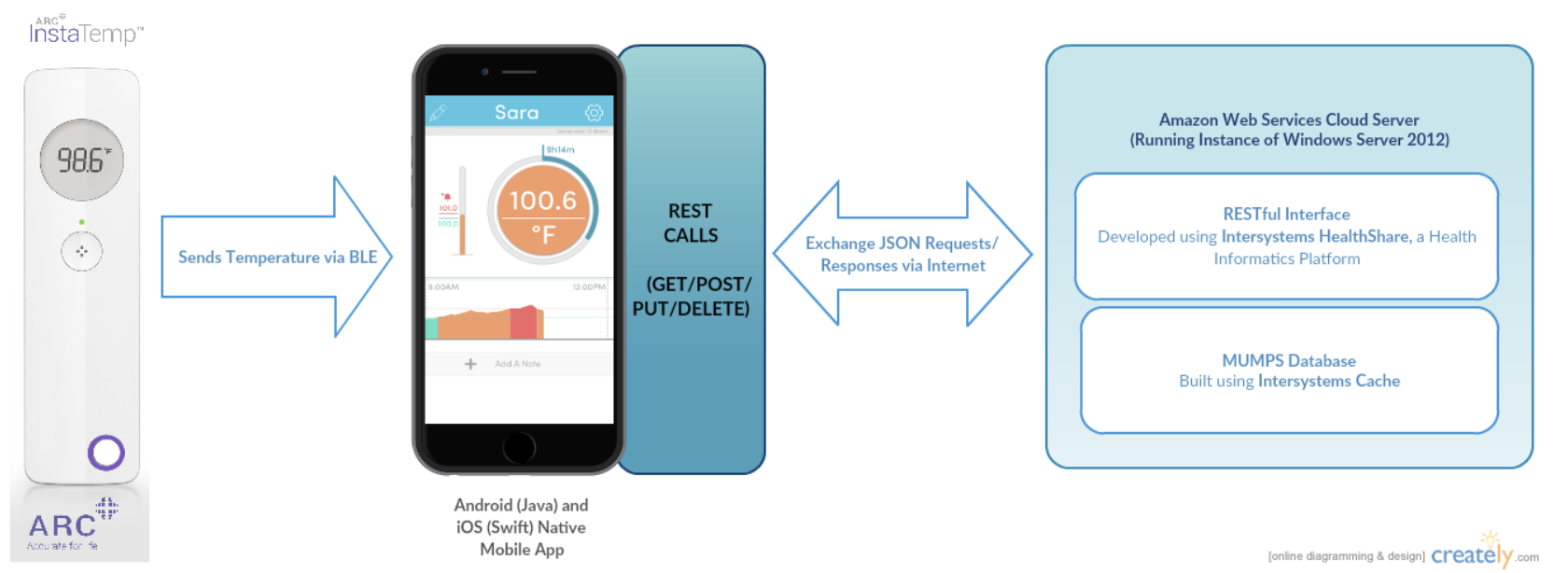
We developed an integrated framework of various tools and technologies for enabling standalone medical devices such as thermometers to communicate with legacy Health IT systems, via a healthcare mobile application. Thus, it gives a contemporary side to a legacy-based Health IT system.
The project involved development of a mobile app (on both Android and iOS platforms) which connects to a Bluetooth-enabled InstaTemp thermometer to smartphones
The objectives achieved by the above-mentioned framework are as follows:
-
Enable standalone medical devices to interface with mobile apps using wireless technology.
-
Store patient’s vitals recorded by medical devices to the patient’s EHR (Electronic Health Record) in existing Health IT systems.
-
Ensure interoperability through exchange of information using latest standard
Providing interfaces between standalone medical devices and EHR systems allows the upload of the vitals measured directly into an individual’s EHR. The individual is able to monitor and track his/her health from home; and the health service provider will have access to the individual’s vitals via the online EHR. This may improve health care and reduce cost. As the framework ensures interoperability by using recently established standards for exchange, data from each individual element of the system can be exchanged easily.
For developing the application, we used Android SDK and Java language for the Android application. For the iPhone application, we used XCode SDK and Swift language. For the back-end, we developed a cloud-based server setup which included – Intersystems Cache as the MUMPS (NoSQL) Database, Intersystems Health Connect (from the HealthShare product family) for API development, and Amazon Web Services for Cloud Deployment.
Design of Airport Electrical Systems
Renovation and expansion of transportation systems require minimization of disruption of service while incorporating best practices and cutting-edge technology to minimize energy consumption. The objective of this project is to analyze, model and document alternative designs and technologies that impact the efficiency of electrical systems used in airports with the goal of attaining maximum LEED certification for new airport constructions and expansions. A case study will focus on the proposed new International Concourse for the Fort Lauderdale-Hollywood International Airport expansion, projected to have 6 new gates for international flights. The research of design alternatives and efficiency maximization of the electrical systems will include alternative technologies such as LED for lighting and photovoltaic systems for fire alarms, to enable increased availability of normal, emergency and life safety power while maintaining service to the existing terminals.
The design analysis will include eleven major systems that require power, including control of lighting, conveyance, temperature, baggage handling, telecommunications, fire alarms and other security systems for emergency and life safety loads. The first phase of the research will focus on alternative designs for a photovoltaic system and analysis and verification that the design meets the systems requirements specified by the Transportation Security Administration and the Broward County Aviation Department.
Driver Drowsiness Detection

Drowsiness causes 7% of all road accidents and mat to blame 18% of fatal collisions.
In this project we are developing a computer vision-based solution to the problem of detecting driver drowsiness based on visual input (images of driver’s face/head) and issuing an alert. We have researched the state-of-the-art in the field, with emphasis on computer vision aspects, such as algorithms and datasets for feature extraction and image classification for related problems
(e.g., open/closed eye classification and head pose estimation).
Our main objective is to implement a mobile prototype (running on a smartphone or comparable device, to be mounted on the dashboard of a car) that is capable of demonstrating how the proposed method achieves its goals in real-time.
Component Evaluation for Physical Phenomenon: Motion and Movement

This project is to develop an important component for medical alert-monitoring systems, which today include GPS satellite tracking technology and location mapping in the event of emergency. The goal of this project has been be to develop an innovative fall detection system. The following research phases were performed:
• Evaluate several commercially available components for developing a fall detection system
• Evaluate the components for varying performance parameters
• Rank the components for an optimized solution
• Propose an algorithm developed from the selected component for motion detection.
The components were selected and the algorithm for motion detection was proposed which used these components. A working prototype for motion detection was built.
Effect of Interference in Relay-Assisted Cellular Networks
Motivated by the increasing demand for higher data rate, broader coverage, and lower infrastructure cost in wireless systems, a major effort is being made to study the use of relay stations in wireless networks. Base stations require considerable infrastructure cost whereas relays require very low-cost, operate at low power, and have no connection to wired infrastructure. Thus, the use of multi-hop relaying can provide considerable performance improvement to a wireless network through coverage enhancement, range extension and capacity enhancement, at relatively low cost to the service provider. Studies have shown that that use of relaying technology is a reliable way to improve the performance through cooperative diversity and extend the coverage of many wireless communication systems. The performance of a multi-hop relaying system with amplify-and-forward (AF) transmission in which the transmitted signal propagates through cascaded nodes, with each node amplifying and forwarding the received signal from the previous node to the next node, is sometimes of interest.
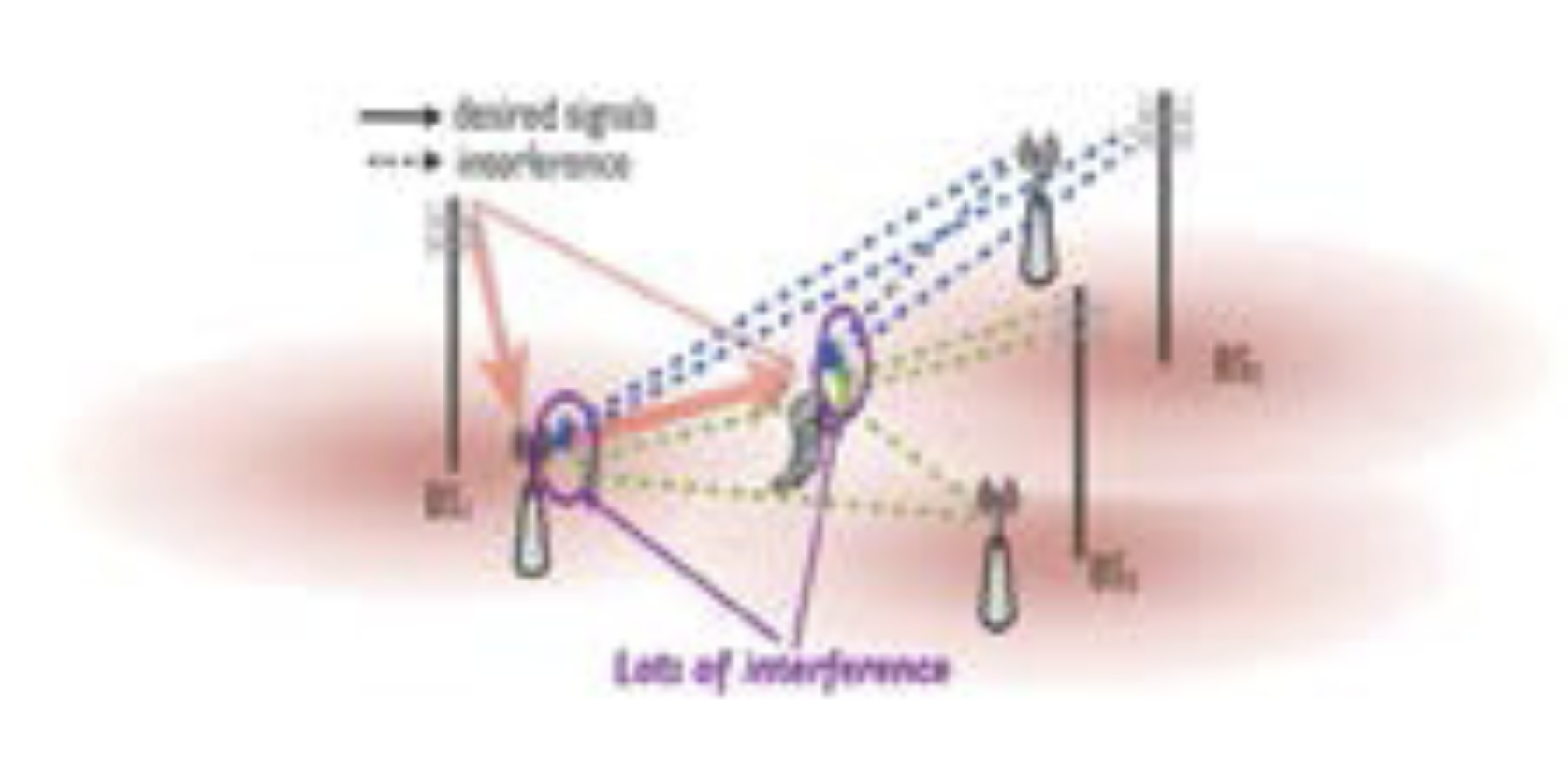
The effect of interference on the performance of multi-hop relay networks has not been studied extensively in the literature. In this work, we develop an analytical tool to study the performance of a multi-hop transmission system with AF relays operating in a generalized fading environment in the presence of co-channel interference and thermal noise.
We assume that the transmitting terminals in a wireless network are distributed in a plane according to a homogeneous Poisson Point Process (PPP). The statistical characteristics of the aggregate interference power at each relay node depends on the statistics of the individual signals, the randomness of which depends on such system characteristics as propagation effects, location of interferer, mobility patterns, and user activity. When the interfering signals sum incoherently, then the aggregate interference can be modeled as a shot noise process whose distribution follows an a-stable distribution under certain conditions. Based on this interference model, we derive the performance of a multi-hop relay network in the presence of thermal noise and interference in a generalized fading environment. The main objective of this work is to quantify the effect of interference on the performance of multi-hop relay networks. To this end, we derive the statistics of the end-to-end signal-to-interference-and-noise ratio (SINR) and several performance metrics in the presence of co-channel interference. Specifically, our goal is to achieve the following: (i) develop a statistical framework to characterize the statistics of a multi-hop relay transmission system in which the relays employ the amplify-and-forward protocol and are located in a series network, (ii) derive closed-form expressions for relevant performance metrics in the presence of interference and noise in a fading environment, (iii) explore ways to cancel or mitigate the detrimental effect interference on system performance and (iv) validate the analytical results with extensive computer simulation using Matlab.
Smartphone Cognitive Networking for Rapid Response
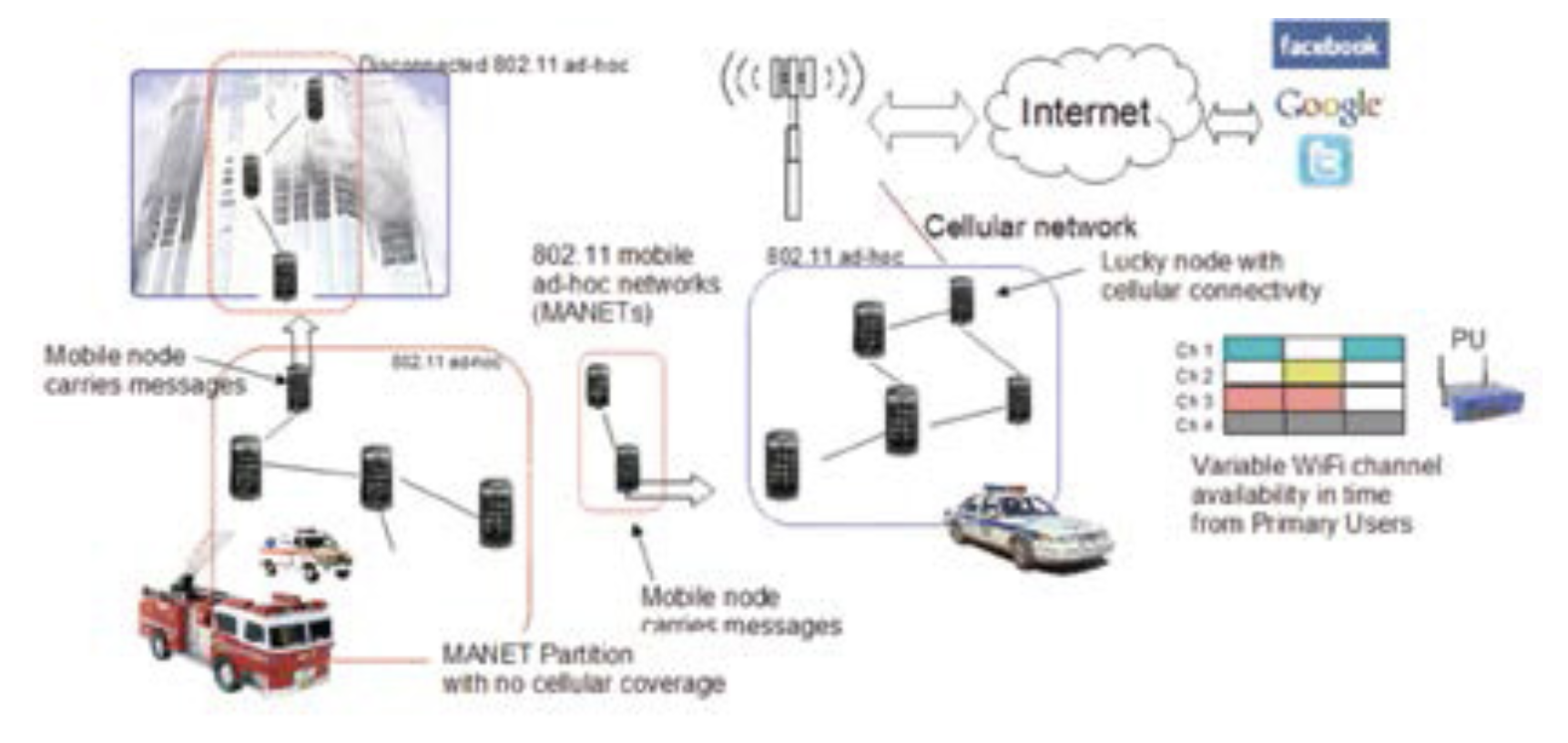
Rapid response teams have to deal with unpredictable RF conditions, sketchy spectrum availability, and system incompatibility.
Collapsed buildings and damaged subway tunnels degrade signal quality inside. Power outages affecting cellular base stations are common after earthquakes and weather disasters. Ubiquitous smartphones with IEEE 802.11 adapters and GPS localization provide a powerful platform for opportunistic communication in difficult environments. Smartphones with IEEE 802.11 adapters configured in ad-hoc mode can form a wireless network that does not need any infrastructure to communicate end-to-end using multi-hop routes. Still, TCP/IP protocols only work if there is a continuously available path between endpoints. With intermittent connectivity, traditional IP MANET routing and transport protocols inevitably fail. The solution is to use Delay Tolerant Networking (DTN) techniques that can tolerate intermittent lack of end-to-end connectivity by storing and carrying messages.
This project develops DTN protocols for rapid response applications that has 802.11 ad-hoc networks self-organize and deliver packets end-to-end when the network topology is dynamic from node mobility and sporadic link availability. The protocols rely on cognitive networking techniques. Channel allocation is aware of availability from primary users (access points), and usage policies in order to prevent interference and to satisfy message quality of service. Message forwarding is scheduled based on contextual information derived from the user’s mission plan and resource availability. Conversely, the mission plan and node trajectory of some nodes is adjusted to serve communication demands using message ferrying.
These technologies will improve the effectiveness of communications for emergency response and for other ad-hoc scenarios using readily available smartphones when circumstances prohibit use of cellular or specialized government radio systems.
Design-Space Oriented Cross -Layer Optimization for Mobile Internet Applications
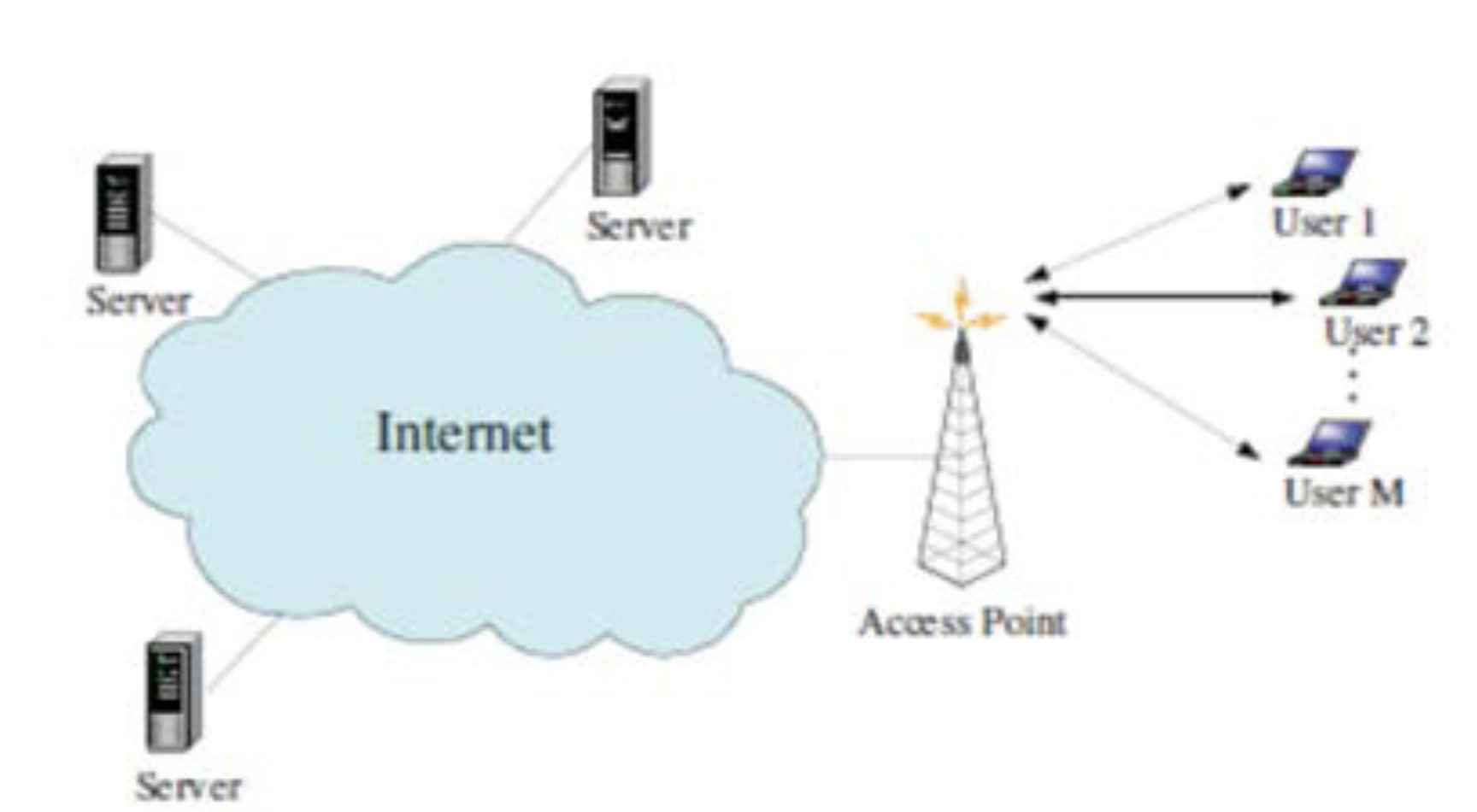 Most of the practical network protocols were designed based on sound yet ad-hoc heuristics. They have performed reasonably well as the Internet scaled up by six orders of magnitude. With the Internet continuing to grow, current protocols need to be re-engineered and optimized for emerging mobile applications
Both engineering heuristics and optimization theoretic approaches were recently employed to enhance/re-engineer the existing network protocols. The resultant schemes, however, either cannot provide analytical performance guarantees, or are difficult to be deployed with the current Internet infrastructure. To fill the gap, this project aims to developing a systematic approach to design and analysis of readily deployable, scalable, yet optimal network schemes for mobile Internet applications. As core of the Internet protocols, the TCP performs window-based congestion control for competing data flows. Adopting queueing delay as the congestion measure, we reveal that TCP window-control mechanism amounts to implicit updates of source rates as “primal variables” and queueing delays as
“Lagrange dual variables” from optimization theoretic perspective. Confining to the design space of Internet, we then envision that the keys to cross-layer Internet optimization are development of non-standard window-control oriented implicit primal-dual solvers for underlying utility maximization problems, and design of jointly optimal network protocols as decomposition of such solvers.
Capitalizing on this original idea, we consider an Internet with wired backbone and a single access point that provides one-hop communications for mobile devices to access Internet. The proposed research will bridge the gap between the current network optimization theory and practical Internet designs, and is expected to benefit directly applications to next-generation Internet protocols and designs.
In an even broader sense, the proposed higher performance network schemes for mobile Internet applications will have an impact on society, if one takes into account how the Internet and wireless devices are expected to transcend various aspects of our everyday life.
Technology breakthroughs
Automated Asset Management in Data Centers
CAKE researchers at Florida Atlantic University developed an innovative solution for visual asset identification using visual features of an image. Visual features of asset images are computed using complex mathematical methods. These visual features are used to identify and match asset images. A database with visual features of asset images was built for every distinct asset that is typically present in large data centers. Assets needing identification are captured using a camera on a mobile device. The device then extracts and transmits the visual features to the server for matching and asset information retrieval. This breakthrough, an optimized version of visual feature extraction and comparison methods, was developed to improve matching accuracy and reduce computational complexity of feature extraction as well as matching. This innovation introduced methods to prioritize and reduce the number of visual features used to identify and match asset images. This reduction in complexity enables efficient asset management solution on mobile devices. This work represents an improvement over previous state-of-the-art technology because it introduces simplified asset management tools based on visual features of assets. This innovative asset management system allows IT personnel to assess the state of computing assets by just pointing a mobile device camera at the asset.
Economic Impact: The advantage of this process is that it enables immediate identification of problematic assets using real-time operational data from the assets without having to explicitly and manually logging into the asset management system. This leads to reductions in data centers’ operational costs by using relatively inexpensive portable devices, such as mobile phones and tablets to minimize human errors, while improving productivity and reducing downtime.
System for Reducing Hospital Readmissions
Researchers at CAKE, in partnership with Soren Technology, developed a system for reducing hospital readmissions. The system integrates several telemedicine, patient care coordination, and clinical decision support systems to identify patients at high risk for re-admission. This is all based on data mining and a statistical analysis engine. The current system focuses on the readmission issues related to COPD. Predictive modeling of readmission is a complex effort. This work represents an improvement over previous state of the art because it enables comprehensive autonomous statistical analyses based on the mining of patient data using a unique process/algorithm. The clinical decision support system developed at CAKE is designed to predict hospital readmission risk for COPD using electronic health records (EHR) information. The COPD clinical decision support system is based on predictive analytics using structured and unstructured patient data to develop a readmission risk profile for a patient being discharged after an initial COPD related hospital admission.
Economic impact: This technology will have significant economic impacts through cost savings associated with reduction in COPD hospital readmissions. However, even the greater potential economic impact could be realized as the solution is expanded to include other diseases and chronic medical conditions.
Distributed Cloud Computing: 3-D Visualization Services for Climate Data on Demand
This breakthrough results from very successful collaborations involving two I/UCRCs, the Center for Advanced Knowledge Enablement (CAKE) at Florida International University (FIU) and Florida Atlantic University (FAU) and the Center for Hybrid Multicore Productivity Research (CHMPR) at the University of Maryland, Baltimore County (UMBC). This breakthrough work makes it possible to deliver a decade of 3-D animated visualizations of spectral infrared (IR) satellite radiance data from instruments on Aqua. These animations use 3-D to show the vertical structure of a decade of global and regional temperature trends occurring at the surface and lower troposphere. In addition, the algorithms developed by CHMPR have been providing CAKE with 3-D temperature profiles that specify the thermal structure around hurricanes in order to improve their landfall prediction. CAKE and CHMPR have implemented a distributed cloud computing web-based service, called SOAR. This service incorporates visualization as a public service available on a multi-core IBM-based server cluster. This system provides researchers and students with the ability to select regional and chronological periods and automatically transform IR orbital satellite data into spherical grid arrays of 3-D temperature profiles for viewing the continuous changing thermal structure of the atmosphere.
Economic impact: Fundamental Decadal Data Records are highly desired products recommended by the National Academy of Science/National Research Council. The SOAR distributed cloud computing web-based service enhances NASA’s ACCESS program by providing fundamental brightness temperature records. This can go a long way towards improving scientific and public understanding of the nature of global and regional climate change. As a result, everyone can be better positioned to design policies and actions for mitigating negative climate impacts on the economy, which could include billions of dollars of property value lost to sea-level rise and billions of dollars of insurable losses due to increases in extreme weather-related disasters.