Career Center
Exploring Majors and Careers
Is your major undeclared? Or do you have a major in mind and need to explore how it translates into a career? You are not alone in feeling undecided about this important decision; more than half of all college students aren't sure either! Our career consultants and career counselors are available to assist you.
Meet with a Career Counselor
If you are interested in clarifying your career goals, exploring career options or evaluating occupational settings, schedule an appointment to meet with a career counselor by calling 561-297-3533. You can also meet with a career consultant during Same-Day Career Advising every Monday – Friday from 9 a.m. – 4 p.m. on the Boca Raton campus (SU 220).
Major Knowledge
Major KnOWLedge is an early exploration tool that helps FAU students identify personal interests and their relationships to career pathways. Major KnOWLedge involves two steps: 1) complete a career interest inventory, and 2) meet with the FAU Career Center to review your results. Click here to access Major KnOWLedge, and you will be one step closer to deciding on a major and/or career!
Watch Career Videos
There are approximately 520 career videos that describe typical work tasks and settings, education requirements, and helpful qualities for hundreds of different occupations. Click here to access the video library provided by Career OneStop.
Research FAU Majors by Holland Type & Career Pathways
According to John Holland’s RIASEC Theory, most people can identify with one of six personality types---- Realistic, Investigative, Artist, Social Enterprising and Conventional. Likewise, most jobs, occupations, and majors can also be categorized as one of the same six types. After completing Major KnOWLedge, use your Holland Type results to research here.
Explore “What Can I Do With This Major?
Do you have a major in mind and need to explore how it translates into a career? Please click here to learn about FAU majors and their related major skills, sample work settings, career titles and additional resources for each major.
SLS 1301: Career and Life Planning Course
SLS 1301 is a 1-credit course instructed by a Career Counselor each fall and spring semester for students who have not yet declared a major or are still exploring their options. The course focuses on self-assessment, choosing a major, exploring career options and developing an action plan to help achieve career goals. The intended audience for the class is first and second year students. Students who take this class will have the opportunity to employ all of the Exploring Majors/Careers strategies listed above while earning class credit.
*For more information on the Career and Life Planning course contact the Career Center at 561-297-3533 or email career@fau.edu.
Discover Career Paths with Steppingblocks
Steppingblocks is a tool that shows you real career paths, salaries, and job trends based on what people with your major are actually doing—so you can plan your future with real data. Still figuring out your major or career path? Try the personality assessment to get personalized suggestions. Click here to access Steppingblocks.
Additional Suggestions
Review the FAU catalog online! Learn about academic offerings at FAU. -Academic Departments - Visit the websites of academic advising in which you are considering a major. Make an appointment with your academic advisor at University Advising Services.
Career Assessments
The process of choosing a major and/or career often begins with self-assessment. The FAU Career Center offers several different career assessments that can help clarify your work values, interests, and skills, while providing important information to enhance personal growth and self-understanding. The career assessments are for currently enrolled degree-seeking students.
The assessments are only a tool in the overall career development process. They will not provide students with the "magical" answer. No single assessment can tell a student "what they should be." Assessments aid students in exploring new options, solidifying current options, and/or acquiring self-knowledge.
| Available Assessments: | Description: |
| Strong Interest Inventory (SII) | The Strong Interest Inventory (SII) is a 291-item inventory that matches your interests with the interests of people who have been in career fields at least three years and are satisfied with their work. The SII is taken online, and the results are provided during an individual appointment with a career advisor ($25) |
| Major KnOWLedge |
Major Knowledge is an online resource developed by career counselors at the FAU Career Center that helps FAU students identify personal interests and their relationships to FAU majors as well as occupations. |
Click Here to Pay for Strong Interest Inventory
Once payment is processed, you will receive follow-up instructions via e-mail. If you do not receive follow-up instructions within two business days, please call the Career Center at 561-297-3533.
Working Together to Build Toward Your Future
In collaboration with the Student Accessibility Services, the Florida Atlantic Career Center assists currently enrolled degree seeking students and registered alumni who have various disabilities by providing career planning services and coaching pertaining to their specific disability related issues. See department’s website here: https://www.fau.edu/sas/
Services Provided:
- Major and career exploration through assessment tools.
- Individual career coaching and career preparation.
- Job-seeking skills.
- Interview prep for self-disclosure skill development.
- Interview techniques and preparation.
- Information regarding rights, responsibilities and options for reasonable accommodation in the workplace.
Things to Consider
As a student with a disability there are important factors for you to consider as you search for internships or employment or apply to graduate school. You may have questions about your rights, disclosure, accommodations and which laws might apply to you. Here are some resources to guide your career:
Your Legal Rights
As a student with a disability you may have concerns about experiencing discrimination within your job search or career and what to do should it arise. The following are resources to help you understand your rights if you encounter discrimination on an application, in a job interview or in the work place:
- For local legal resources specifically related to disability contact the Disability Rights Florida.
Disclosing a Disability
Issues to Consider about Disclosure
- Prepare for how and what you might disclose: Spend some time examining your feelings about your disability. How comfortable are you discussing it? Identify accommodations you might need to request in order to perform the new position. Weigh the advantages and disadvantages of disclosing your disability at different points in the job-search process. (See below for tips about specific timing.)
- If you do plan to disclose your disability: Decide how detailed you want to be. Study the job description. Be ready to describe the skills you have that make you qualified for the position and capable of doing it well. Also be prepared to discuss any limitations caused by your disability, and workplace accommodation needs. Be informative but concise, and expect to be asked questions.
- Consider invisible vs. visible disabilities: A visible disability might put you in the position of having to discuss it. Be prepared for that. If you have workspace accommodation needs, you may want to discuss that at the same time. Be aware that some employers will make assumptions about a visible disability, so your disclosure can be an opportunity to correct any misconceptions about your ability to do the job effectively.
- Be able to clarify workplace accommodations if you discuss them. One of the unspoken concerns some employers will have is the cost of workplace accommodations, even though they often turn out to be minimal or free. You may want to briefly explain what you need and what the costs would be (e.g., inexpensive, free, or a specific sum).
- Preparing a script in advance can be helpful: After you've considered what you want to say, write it down. Keep in mind the potential employer wants to know 3 things:
1) Will you be reliable?
2) Can you do the job as well or better than anyone else? and
3) Will you be valuable to the organization?
Practice what you want to say until you feel comfortable with it. (See below for script ideas.) While discussing your disability, positively describe your skills. The more you focus on your disability, the more relevant it will become to the employer. The more positive you are about what you can do, the more your strengths and personality will come across over any disability issues. - If you decide not to disclose your disability: Be sure you can perform the essential functions of the position before accepting it. If you can't—for whatever reason—you can be fired for that later. Be aware that the employer can't make helpful accommodations unless you disclose what you might need. Also, if an emergency medical situation were to arise while you were at work, you may want to have explained what should be done to help.
Suggested Disclosure Script
"I have ___ (preferred term for disability). I do have the skills and ability to do this job. It helps if I have ____(specific accommodations you need). I am confident I can do the job well, and I would look forward to the opportunity to contribute to ____ (organization or company name)."
The point is that you and your future employer must both feel comfortable.
Disclosure Timing Options: Pros and Cons
As you read the tips below, keep in mind that some potential employers will be comfortable with your disability disclosure and some won't, no matter when or how you disclose it. What's more important is how comfortable you are. The more comfortable you are, the more likely you are to be effective in the job search, and to find a position that's a good fit.
Disclose on Your Resume or Cover Letter
Pros: You're being honest and can have some peace of mind. Let the employer decide if disability is an issue.
Cons: Might disqualify you before you can present your qualifications. You might have a harder time finding work.
Disclose When an Employer Calls for an Interview
Pros: Honesty. Provides you with peace of mind. Reduces the element of surprise before you meet in person. The employer may feel more comfortable being told in advance of a potential interview.
Cons: You might not be considered as seriously. Your performance abilities may be doubted before you've had a chance to discuss them.
Disclose During the Interview
Pros: Honesty. Demonstrates your confidence and poise. Allows you to explain briefly and positively in person. Discrimination is less likely face-to-face.
Cons: The surprise factor may make the employer uncomfortable. Employer may be distracted during the interview or doubt your ability to perform. Puts the responsibility on you to avoid over-explaining your disability, and to mention it at an effective time. (TIP: Bring up your disability at a natural time—when you're discussing job qualifications and duties. Be concise and focus on the positives—how well you can do the position.)
Disclose After The Interview But Before You Start a Position
Pros If accommodations are needed, the employer will have a chance to arrange them before you arrive.
Cons: Employer may distrust you for waiting to disclose.
Disclose After You Start a Position
Pros: You get a chance to prove yourself on the job before disclosure, and discuss it with coworkers if you choose. (NOTE: If your disability doesn't impact job performance, but your employment situation somehow changes after disclosure, you may have legal recourse.)
Cons: The longer you put off disclosure, the harder it becomes. It may be difficult to reestablish trust afterward. The employer might accuse you of falsifying your qualifications. Coworkers may treat you differently and the office climate could become poor.
Disclose After a Job-Related Problem Cause by Disability
Pros: You've had a chance to prove yourself on the job before disclosure.
Cons: Employer might accuse you of falsifying your qualifications. If you disclose now (rather than never), the employer may think you're unable to perform the essential job duties. Relationships with your coworkers or supervisor may be hurt if they feel you haven't been honest.
Resources
Disability Friendly Job Boards
- Handshake - FAU’s centralized online job search portal. It is available to all currently enrolled degree-seeking FAU students and registered alum and allows you to: Search for job postings for full-time, part-time, and Co-op & internship opportunities; Submit resumes to employers; Apply for on-campus interviews; Have employers view your resume and profile; and stay informed of career events.
- Entry Point - Internship opportunities for students with disabilities in science, engineering, mathematics, computer science, and some fields of business
- Volunteer Match - Matches volunteers with opportunities.
- Autism Friendly Businesses - https://www.fau.edu/education/centersandprograms/card/autism-friendly-business-directory/
- Disability Solutions - https://jobs.disabilitytalent.org/
- Ability Jobs - https://abilityjobs.com/
- Equal Opportunity Publications, Inc. - https://eop.com/career-center/
- Career One Stop - https://www.careeronestop.org/ResourcesFor/WorkersWithDisabilities/job-search.aspx
Career Exploration and Preparation
- The Sierra Group Recruit Disability - The first step for any job seeker with a disability.
- Stand Among Friends - Stand Among Friends is a non-profit organization located on FAU’s Boca Raton campus that helps college students and adults with disabilities prepare for, seek and secure active employment.
- Careers and the Disabled Magazine - established in 1986, is the nation's first and only career-guidance and recruitment magazine for people with disabilities who are at undergraduate, graduate, or professional levels. Each issue features a special Braille section.
- DO-IT - For people with disabilities pursuing college and careers in the fields of business, science, technology, engineering, and mathematics.
- Hire Disability Solutions - Empowers individuals with disabilities to reach their goals by providing them with the tools to succeed. They present information and resources for individuals to connect with employers, build their skills, and discover the feeling of accomplishment.
- Job Accommodation Network - International toll-free consulting service that provides information about job accommodations, the employability of people who have disabilities, and other information regarding the Americans with Disabilities Act.
Professional Networking and Campus Involvement
- Professional associations are groups of people who work in a specific industry or field of study. Meeting with other students or professionals who have successfully made the transition from student to professional is a great way to gain useful information and network. Create an account on the online professional networking site LinkedIn and join groups.
- Attend career fairs, organization information sessions/networking events, and employer panels to expand your professional network. View campus events on FAU’s calendar of events.
The following are resources focused on mentorship programs:
American Association of People with Disabilities
Advancing Science, Serving Society
National Organization on Disability
Independent Living Institute Global Networking
World Institute on Disability
Scholarships for Students with Disabilities
- Public Service Degrees - https://www.publicservicedegrees.org/financial-aid/scholarships/students-with-disabilities/
- Career One Stop - https://www.careeronestop.org/ResourcesFor/WorkersWithDisabilities/job-search.aspx
Premium Resources
- Big Interview - Big Interview is a free premium resource exclusive to Florida Atlantic students and alumni. To access our Practice tools, click on the Practice tab. We have four different tools in this area: Practice Interviews, Answer Builder, Interview Roulette, and the Question Library. As a premium user, you have access to the AI Feedback. The AI Feedback feature is a great way to improve your interviewing skills and pinpoint your strengths and weaknesses. When you save a video, the AI will process your video and then offer you immediate feedback on key behaviors and coaching on how to improve. At the conclusion of your practice interview, you can review your responses and save or rerecord them.
To get Started:
Go to https://fau.biginterview.com/.
Click Register at the upper right hand corner, and make sure to use your FAU e-mail address when creating your account. When you log in, you will see a dashboard where you can watch overview videos for an introduction to the platform. On the Dashboard you will also be presented with recommended learning tracks and practice tools. Questions? Check out the Student User Guide or contact the Career Center!
- LinkedIn Learning - LinkedIn Learning is a leading online learning platform assisting active FAU students, faculty, and staff to discover and develop skills through an online library of high-quality expert-led videos and courses. To start using LinkedIn Learning, log in using your FAU username and password to activate your Account: https://www.fau.edu/linkedin-learning/
- JobScan - Jobscan is a resume software tool that analyzes your resume for how it would perform in an ATS. The premium Jobscan account will allow you to perform unlimited scans of your resume to see how it performs in various Applicant Tracking Systems. In order to use Jobscan, you will create an account using your FAU email address. By using your FAU email address, you will be able to get all of the premium features, including unlimited resume, cover letter and LinkedIn profile scans. Access it here: https://app.jobscan.co/dashboard
On-Campus Interview Program
The FAU Career Center hosts an On-Campus Interview program that brings numerous organizations to campus during the fall, spring, and summer semesters.
Eligibility for On-Campus Interviews
- Completion of Student Profile on Handshake
- Upload your updated resume onto Handshake for approval
- The on-campus interview program is only open to current students and alumni
Process
- Use Handshake to view the upcoming on-campus interview schedules, review position information and qualifications, and submit your resume to request an interview. *Please note that new interview opportunities are posted often so be sure to visit Handshake to view new updates.
- Interviews take place on both the Boca Raton campus and the Davie campus. Pay attention to the location of the interview.
- If selected for an interview, you will be notified by Handshake. Once notified that you have been selected, you must schedule your interview on Handshake. On-campus interviews typically last 30-45 minutes.
- On-campus interviews take place in the FAU Career Center in Student Support Services (SU-80) room 220 (Boca Raton) or LA 109 (Davie). Professional business attire is required, and you should arrive at least 10 minutes before your interview time. Be sure to always bring extra copies of your resume to your interview.
- To prepare for interviews, the Career Center recommends that you review the information available under Interview web page.
- Prior to your interview, we encourage you to review the job description on Handshake and to research the employer using the print materials you collected at a career fair and/or the company’s website.
- Questions should be directed at recruit@fau.edu.
Apply for an On-Campus Interview
- Log into Handshake using your MyFAU login information
- Select the Jobs link at the top of your Handshake homepage
- Select On-Campus Interviews on the top right of the page
- Select the company with which you would like to interview
- Click on the job for which you would like to interview and apply for the job
- Once you have been chosen by an employer for an On-campus interview, you will receive a notification in Handshake and an email from Handshake to schedule your time slot
- Select the interview in order to see all available time slots. Simply select "Take Slot" to reserve that time for yourself to interview. If for any reason you need to change your time slot to a different time, you can either simply select a new time slot it is open or you can "request to swap" with another students, but it is not guaranteed the swap will be approved
No Show/Cancellation Policy
General Policy
The FAU Career Center requires that all students/alumni participating in the On-Campus Interview (OCI) Program cancel interviews in advance if they cannot keep an interview appointment as scheduled. When a student fails to cancel an interview in a timely fashion or does not appear for the interview, those actions reflect poorly on the student as an individual and on the University as a whole. Not only is the employer inconvenienced, but this action may also deprive another student of a valuable interview opportunity. These situations, if not taken seriously, may also have long-term implications on the University's overall relationships with employers, which in turn could impact the number of employers recruiting at FAU.
The FAU Career Center advises students to take special note of the following Cancellation and No Show Policy procedures:
How do I cancel an interview?
Students must cancel interviews no later than one (1) business day before the scheduled interview date to avoid a penalty. To cancel follow these steps:
- Login to Handshake
- Select Jobs from the top menu
- Select Applications
- Locate your pending interview
- Click on the interview title
- On the next page, click on Leave Slot
Note: Students will only be able to cancel online before 11:59 pm through the stated Sign-up End date noted under Timeline on the interview page. The Sign-up End date varies by employer and schedule -- typically from 2-4 days before the interview date.
What if I missed the deadline to cancel?
If there is no option to cancel the slot, then the deadline to cancel has been missed and the FAU Career Center must be contacted immediately by calling (561) 297-3533 by 5:00 pm, or sending an email to recruit@fau.edu. Students must provide complete details: name, FAU net ID, company name, date/time of interview and position number/title.
Note: Violations to this policy will result in a penalty. Refer to the Late Cancellations and No Shows section below for penalties and appeal procedures if you are canceling late or fail to show up for your appointments.
What if I have an emergency the day of the interview?
In the event of a sudden illness or extreme personal emergency on the interview day, students are expected to contact the FAU Career Center at (561) 297-3533 no later than 8:30 am.
Late Cancellations and No-Shows Violation Penalties and Appeal Process
If students cancel appointments with less than one (1) business day notice (late cancellation) or fail to show up for an interview (no-show), the FAU Career Center will treat these instances seriously and will enforce a system with the following penalties:
|
First Violation |
Second Violation |
Reinstatement |
|
|
Late Cancellation (canceling an interview with less than one (1) day notice) |
Warning email and will be required to meet with a career counselor. |
Handshake account will be blocked for the remainder of the semester. |
Meet with Director of Career Education and Coaching. |
|
No-Show (fail to appear for an interview with no prior notice) |
Warning email and will be required to meet with a career counselor. |
Handshake account will be blocked for the remainder of the semester. |
Meet with Director of Career Education and Coaching. |
What does it mean to have my Handshake Account blocked?
Students will not be able to submit resumes, schedule interviews or view interview schedules. Students whose Handshake account is blocked will need to call the FAU Career Center at (561) 297-3533 to schedule a counseling appointment.
Employers will not be able to send invitations for interviews or download applications for jobs students had already applied.
It is important to note that students will be expected to honor all previously arranged interviews during their suspension period. Because students will not have access to view their account during this suspension period, students will have to contact the Career Center to request information about prior set interview schedules. Email recruit@fau.edu to request a copy of any upcoming interview schedule.
Students will be notified by the Director of Career Education & Coaching of their suspension. Students may appeal their suspension if there were extenuating circumstances (as outlined below). If no appeal is made, the FAU Career Center will automatically deactivate the student’s Handshake access for the prescribed time frame (duration of the semester).
What is the Appeal Process?
Students may appeal their suspension if there were extenuating circumstances that resulted in a late cancellation or a no show for an interview. Acceptable excuses might include a car accident, sudden hospitalization, family emergency, etc. - all subject to possible verification. Unacceptable excuses would include last-minute preparation for exams, projects or term papers, getting up late, forgetting, or not checking your OCI schedule.
Follow these appeal procedures:
-
Send an email to recruit@fau.edu within 48 hours explaining why you canceled late or did not show up for the interview. Include the organization name, schedule number, interview date and time for your missed appointment.
-
If there were any substantiating documentation (medical excuse, car towing receipt, accident report, etc.), students are encouraged to email that documentation to the FAU Career Center at recruit@fau.edu.
-
Upon receipt of this information, a committee will review your case and advise you of the final decision.

Graduate Students
The FAU Career Center offers a variety of services to help Graduate Students achieve their career goals, including, but not limited to:
- CV and Resume Critiques
- Academic and Non-Academic Mock Interviews
- LinkedIn Profile Review
- Specialized Workshops
- Academic and Non-Academic Job Search Assistance
- Collaborations with Graduate and Professional Student Association (GPSA) and the Graduate College to offer networking events
CV & Resume Writing
Preparing a dynamic CV & resume will help you prepare for your job and internship search.
Upload your CV & Resume for a virtual critique through Handshake:
Watch this short video or see below.
- Step 1: Sign in to Handshake using your FAU net ID and password
- Step 2: If this is your first time signing in, activate your account and answer the questions
- Step 3: On the home page, click on your name in the upper right corner and then click on “Documents”
- Step 4: Click on the “Add New Document" button
- Step 5: Click on “Choose File” and upload your Resume as a .doc or .pdf file then click “Save”
FAU Sample CV & Resumes
Sample Materials for Applications to Faculty Positions
[Under construction for Florida Atlantic University]
These samples have been generously donated by University of California San Francisco (UCSF) students, postdocs, and alumni, and carefully organized by the Office of Career & Professional Development at UCSF, to offer ideas about how to present skills and experiences while applying to faculty positions.
Source: https://career.ucsf.edu/phds/academic-careers/academic-samples
Two-Year Career Action Plan
Create your strategy for gaining experience and successfully building toward your future. Become internship and career ready. Regularly visit with a career coach throughout your time at FAU.
Learn how to schedule an appointment at https://fau.edu/career/students/
THIRD YEAR
Specific Careers & Graduate Programs
- Narrow your career focus and follow companies/organizations/programs of interest on social media, Handshake or LinkedIn.
- Explore graduate school & speak to faculty to learn about programs and graduate student positions to help fund your education.
- Identify graduate school & internship search resources to organize your search.
Prepare for the Internship/Job Search
- Create a resume and get it critiqued with a career coach.
- Identify internships or organizations in Handshake of interest.
- Do a practice mock interview to gain experience with interviewing.
- Attend the Internship & Part-Time Job Fair (available every fall and spring semester).
- Get a free Professional Headshot at the Career Centers’ in-house photo studio & professional attire, as needed, from the Owl’s Professional Clothes Closet.
- Participate in a job shadow experience through the FAU ExSEL program.
Network
- Consider what types of companies or locations you are interested in working at and attend networking events, workshops and career fairs to start making connections.
- Utilize Handshake’s Student-Alumni Community Resource or Owl Alumni Networks to connect with FAU alumni who had similar experiences and interests.
- Create a professional LinkedIn profile, join LinkedIn groups of interest and connect with 25 individuals that you find interesting.
Secure an Internship
- Apply to internships the semester before you intend to intern.
- Consider earning academic credit for your internship and enrolling in IDS3949.
- Find ways to stand out at your internship by meeting with an Internship Specialist.
- Attend the JCPenney Suit-Up event or visit the Owl Professional Clothes Closet to start building your professional wardrobe.
Recommended Online Tools
https://fau.interviewprep.app
Utilize
LinkedIn
,
Handshake
and
Owl Networks
Handshake Job/Internship and employer postings
Fourth Year
Apply for Jobs and/or Graduate Programs
- Research and learn companies’ benefit options and decide what is important to you.
- Prepare and submit application materials for jobs or graduate programs.
- Prepare to take graduate entrance exams (GRE, MCAT, LSAT), if needed, or obtain other certifications/licensures related to your career goals.
- Consolidate your post-graduation strategy and plans.
- Attend the Career Expo, other career fairs and other networking fairs.
Prepare for the Transition from College to Career
- Learn how to make an impact at your first job out of college and how to leverage your skills to stand out.
- Adapt to a new work schedule by using calendar tools such as Google Calendar or Outlook.
- Update your professional headshot.
Maintain Networking Contacts
- Stay connected with faculty and colleagues after you leave FAU.
- Join the FAU Alumni Association.
- Remain active on Handshake and LinkedIn.
Note- Handshake is available to you as an alumni and career services are free up to one-year post-graduation.
Recommended Online Tools
FAU Handshake
FAU Alumni Association
Four-Year Career Action Plan
From Here to Career:
Create your strategy for gaining experience and successfully building toward your future. Become internship and career ready. Regularly visit with a career coach throughout your time at FAU.
Learn how to schedule an appointment at https://fau.edu/career/students/
Explore Majors and Careers
- Activate your Handshake Account.
- Meet with a career coach (at least once every semester).
- Take a work interest assessment through Major Knowledge.
- Enroll in the one-credit SLS1301: Career & Life Planning elective course.
- Explore Steppingblocks to learn about career paths, salaries, and job trends based on what people with your major are actually doing.
Focus on Academics
- Set up a study schedule and get involved with study groups with classmates.
- Attend all classes; don’t sit in the back and keep your camera on for virtual learning.
- Utilize the Center for Teaching & Learning for free tutoring services.
Get Involved
- Connect with Student Activities and Involvement to join a student organization through OwlCentral.
- Find a group of friends through your classes, student organizations, intramural sports or by attending on-campus activities.
- Volunteer at local organizations or find opportunities through the Weppner Center.
Recommended Online Tools
- FAU Handshake account
- Major KnOWLedge Self-Assessments
- What Can I Do With This Major
- Owl Central & Weppner Center
- Steppingblocks
SECOND YEAR
Select Your Major(s) & Career Direction
- Declare your major and start researching career options within the declared major.
- Learn about top career skills employers seek by meeting with a career coach.
- Develop relationships with faculty & administrators to start building your professional network and attend a networking workshop to learn how to effectively network.
Take an Active or Leadership Role
- Become more involved by serving on a committee or obtaining a leadership role in a student organization.
- Attend Leadership events (iLead, WeLead) and engage with the Office ofLeadership Education & Development (LEAD).
- Consider getting an on-campus job or part-time job.
Prepare for the Internship Search
- Create a resume and get it critiqued with a career coach.
- Identify internships or organizations in Handshake of interest.
- Do a practice mock interview to gain experience with interviewing.
- Attend the Internship & Part-Time Job Fair (available every fall and spring semester).
- Get a free Professional Headshot at the Career Centers’ in-house photo studio & professional attire, as needed, from the Owl’s Professional Clothes Closet.
- Participate in a job shadow experience through the Owls-On-The-Job Shadow program.
Recommended Online Tools
Handshake Job/Internship and employer postings
Career Advice on Demand Videos
O*Net/Occupational Outlook Handbook
THIRD YEAR
Specific Careers & Graduate Programs
- Narrow your career focus and follow companies/organizations/programs of interest on social media, Handshake or LinkedIn.
- Explore graduate school & speak to faculty to learn about programs and graduate student positions to help fund your education.
- Identify graduate school & internship search resources to organize your search.
Network
- Consider what types of companies or locations you are interested in working at and attend networking events, workshops and career fairs to start making connections.
- Utilize Handshake’s Student-Alumni Community Resource or Owl Alumni Networks to connect with FAU alumni who had similar experiences and interests.
- Create a professional LinkedIn profile, join LinkedIn groups of interest and connect with 25 individuals that you find interesting.
Focus on Career Skills Attained
- Attend a career skill session to learn about career skills and gaps you may have.
- Conduct a practice interview to articulate career and transferable skills.
- Complete a career skill self-assessment to identify strengths and areas of opportunities.
Secure an Internship
- Apply to internships the semester before you intend to intern.
- Consider earning academic credit for your internship and enrolling inIDS3949.
- Find ways to stand out at your internship by meeting with an Internship Specialist.
- Attend the JCPenney Suit-Up event or visit the Owl Professional Clothes Closet to start building your professional wardrobe.
Recommended Online Tools
- https://fau.interviewprep.app
- UtilizeLinkedIn,HandshakeandOwl Networks
- Handshake Job/Internship and employer postings
FOURTH YEAR
Apply for Jobs and/or Graduate Programs
- Research and learn companies’ benefit options and decide what is important to you.
- Prepare and submit application materials for jobs or graduate programs.
- Prepare to take graduate entrance exams (GRE, MCAT, LSAT), if needed, or obtain other certifications/licensures related to your career goals.
- Consolidate your post-graduation strategy and plans.
- Attend the Career Expo, other career fairs and other networking fairs.
Prepare for the Transition from College to Career
- Learn how to make an impact at your first job out of college and how to leverage your skills to stand out.
- Adapt to a new work schedule by using calendar tools such as Google Calendar or Outlook.
- Update your professional headshot.
Maintain Networking Contacts
- Stay connected with faculty and colleagues after you leave FAU.
- Join the FAU Alumni Association.
- Remain active on Handshake and LinkedIn.
Note- Handshake is available to you as an alumni and career services are free up to one-year post-graduation.
Recommended Online Tools
Florida Atlantic Handshake
Florida Atlantic Alumni Association
Informational Interview Guide
Faculty mentors
One of the most effective ways to acquire information from people in a professional field in which you are interested is to conduct informational interviews. Informational interviewing is a networking approach that allows you to meet key professionals, gather career information, investigate career options, receive advice on job search techniques and obtain referrals to other professionals.
An informational interview is an interview that you initiate and you ask the questions. The purpose is to obtain information, not to get a job. Thus, never abuse your privilege by asking for a job.
The following are good reasons to conduct informational interviews:
- To explore careers and clarify your career goal
- To discover employment opportunities that are not advertised
- To expand your professional network
- To build confidence for your job interviews
- To access the most up-to-date career information
- To identify your professional strengths and weaknesses
Steps to follow when conducting an informational interview:
- Identify the Occupation or Industry You Wish to Learn About
Assess your interests, abilities, values, and skills, and evaluate labor conditions and trends related to your professional interests. - Prepare for the Interview
Read all you can about the field prior to the interview. Decide what information you would like to obtain about the occupation/industry. Prepare a list of questions that you would like to have answered. Prepare an updated resume and bring it with you. (The Career Development Center can help you prepare and/or critique your resume). - Arrange the Interview
Contact your mentor to set up an interview. It is recommended that that interview take place in person, but informational interview can also be conducted over the phone and/or via e-mail. The mentor typically verbalized their preference. - Conduct the Interview
Dress appropriately, arrive on time, be polite and professional, refer to your list of prepared questions; stay on track, but allow for spontaneous discussion. Before leaving, ask for names of others who might be helpful to you and ask permission to use your mentor’s name when contacting them. - Follow Up
Immediately following the interview, record the information gathered. Be sure to send a thank-you note to your mentor within one week of the interview.
NOTE: Always analyze the information you’ve gathered. Adjust your job search, resume, and career objective if necessary.
22 QUESTIONS!
Prepare a list of questions that are relevant to you and what you would like to obtain from your informational interview. Following are some sample questions:
- (Work Environment) On a typical day in this position, what do you do?
- (Background) What training or education is required for this type of work?
- (Background) What personal qualities or abilities are important to being successful in this job?
- (Work Environment) What part of this job do you find most satisfying? Most challenging?
- (Background) How did you get your job?
- (Potential) What opportunities for advancement are there in this field?
- (Background) What entry level jobs are best for learning as much as possible?
- (Salary) What are the salary ranges for various levels in this field?
- (Potential) How do you see jobs in this field changing in the future?
- (The Industry) Is there a demand for people in this occupation?
- (The Industry) What special advice would you give a person entering this field?
- (Training) What types of training do companies offer persons entering this field?
- (Background) What are the basic prerequisites for jobs in this field?
- (Referral to Other Information Opportunities) Which professional journals and organizations would help me learn more about this field?
- (Background) What do you think of the experience I’ve had so far in terms of entering this field?
- (Problems) From your perspective, what are the problems you see working in this field?
- (Advice) If you could do things all over again, would you choose the same path for yourself? Why? What would you change?
- (Advice) With the information you have about my education, skills, and experience, what other fields or jobs would you suggest I research further before I make a final decision?
- (Advice) What do you think of my resume? Do you see any problem areas? How would you suggest I change it?
- (Referral to Others) Who do you know that I should talk to next? When I call him/her, may I use your name?
- (Life Style) What obligation does your work put on you outside the work week? How much flexibility do you have in terms of dress, work hours, vacations?
- (Rewards) What do you find most rewarding about this work, besides the money?
Applying to Graduate School
The FAU Career Center offers a variety ofservices and workshopsto assist undergraduate students in exploring, comparing, and applying to graduate school programs. These services include, but are not limited to:
- Use the Petersons’s Graduate School search
- Visit the FAU Graduate School webpage
- Request an Information Interview with industry experts by usingLinkedIn
- Research career fields and industries usingMyNextMoveand theOccupational Outlook Handbook
- LearnWhat Can I Do With This Major?
- See what educational requirements current employers are actively looking for via Job Search Websites such asLinkedIn,Handshake, Indeed.com andIdealist.org.
- Speak with your professors who have worked in the industry, or make an an appointment with a Career Counselor
- Search and apply to variousFellowships and Grantsat the institution you will be attending
- Submit yourFASFAand apply for Financial Aid
- Research whether your program offersGraduate Assistantships
Almost all graduate programs require students to take a standardized test. As an FAU student, you have access to the FAU Test Preparation office, which provides a number of services at a discounted price.
- FAU Test Prep Office
- GRE Exam (for most graduate programs)
- LSAT Exam (for law schools)
- MCAT Exam (for med schools)
- GMAT Exam (for most business schools)
- It is recommended that students begin forming relationships with their undergraduate professors and internship supervisors prior to their senior year. Students are encouraged to stay after class, attend office hours, and ask to work on research projects alongside faculty. By allowing faculty to observe both your personal and academic qualities, they will be able to contribute a strong, well-rounded letter of recommendation.
- Below are a list of additional tips on how to ask for a letter of recommendation:
- Always ask to meet with the potential recommender in person in order to request a recommendation letter. You will be able to see their nonverbal behavior in order to gauge whether they are excited or less-than-enthused about this prospect.
- Ask your recommenders if they are willing to write a strong recommendation letter which will speak to your unique strengths and qualifications. This will be helpful in competitive fields or if your grades are less-than desirable.
- Provide your recommenders with a copy of your Resume/CV, a list of potential schools you are applying to, and a statement of intent about why you are applying to graduate school.
- Provide your recommenders with several weeks to complete their letter, and check-in with them every few weeks to see if they need any additional documents or clarifications.
- Send a hand-written thank-you card to each recommender after they complete their letter, and make sure to inform them (via phone, or in-person) of the result of your application status.
Graduate School Application Checklist
In addition, the FAU Career Center also provides a “checklist” of steps that you can take in the application process. Please be advised that each graduate program may have varying deadlines and/or requirements, so this “checklist” is a suggestive guideline and may not be applicable to every program or individual.
Click Here to View the Graduate School Checklist
Need more one-on-one assistance?
Undergraduate students and alumni who have graduated within the past year are welcome to attend our Same-day Career Advising. Alumni who have graduated or been working for more than a year are asked to visit the FAU Alumni Career Services page for more information.
Drop-In Career Coaching
Meet with a Career Consultant for a 20-minute walk-in career advising session. First come, first served.
Boca Raton Campus:
Monday - Friday
SU-80 Bldg., Rm. 220
Appointments
Make an appointment with a certified Career Counselor for a 50-minute career counseling session.
To schedule an appointment, please call:
Boca Raton campus: 561-297-3533
Davie & Jupiter campuses: 954-236-1214
Welcome Veterans!
FAU’s Career Center's comprehensive range of services is available to enrolled degree seeking undergraduate and graduate Veterans. When enrolling at FAU, you bring a host of exceptional and sought-after skills that prospective employers and graduate schools seek. The Florida Department of Veterans Administration indicates ten reasons to hire military vets at their website: Florida Department of Veteran's Administration.
Employers of FAU graduates recognize skills that are unique to our veterans, including leadership, teamwork, diversity, overseas experience, and training in the latest technology! A FAU college education will equip you with an advanced set of skills and open new doors to professional career opportunities for your future.
FAU’s Career Center’s professionally trained and nationally certified career counselors will assist you in exploring career options, help you gain career-related experience through our internship program, develop your job search skills, help you craft your resume, or conduct mock interviews to help prepare you every step of the way. Upon meeting with a counselor, you may take an online career assessment inventory to help you clarify your interests, values, and skills in relation to choosing a major and or career path.
Tips for Veterans:
- Visit the Career Center early on so we can get you going in the right direction
- Upload your resume into Handshake
- Drop in during Same Day Career Advising hours to get quick answers to your initial questions
- Attend Career Center events such as Career Fairs and Career Expo, Workshops and Professional Graduate School Day
- Meet with a career counselor for assessments, internships, and to apply for graduate and professional schools, or full time jobs
Job resources for Veterans:
Interviewing
Interviewing is an important part of the career development process. Practice Interviews are simulated interviews, designed to develop or test the communication skills of the interviewee. We offer a practice interview service with a Career Center staff member to help you prepare for professional interviews.
Interviewing Resources
Need interviewing clothes? Check out the OWL PROFESSIONAL CLOTHES CLOSET and WHAT TO WEAR
Self-Paced Virtual Practice Interview
Big Interview is a free premium resource exclusive to Florida Atlantic students and alumni. When preparing for a job interview, it's not enough to only read advice - you need to put that advice into practice! That's why Big Interview isn't just a training course. You'll also get hands-on practice with practice interviews tailored to your specific major or area of interest. The Fast Track is intended for users who have an interview coming up in the next few days or don't have a lot of time to prepare. It takes about an hour and a half to complete. The Mastery Track covers more in-depth content for more competitive/difficult interviews.
To access our Practice tools, click on the Practice tab. We have four different tools in this area: Practice Interviews, Answer Builder, Interview Roulette, and the Question Library. Feel free to try them all out, but we encourage you to start with Practice Interviews. When you click on the Practice Interviews area, you will see six interview categories to choose from. We recommend that you start with General Practice as these practice interviews will cover 80% of questions that come up in actual interviews.
As a premium user, you have access to the AI Feedback. The AI Feedback feature is a great way to improve your interviewing skills and pinpoint your strengths and weaknesses. When you save a video, the AI will process your video and then offer you immediate feedback on key behaviors and coaching on how to improve.
At the conclusion of your practice interview, you can review your responses and save or rerecord them. If you seek additional advice, share your responses with your career coach and discuss other interview techniques.
If you don’t have a webcam, you can call 561-297-3533 to schedule a time to practice your interviewing skills in the Career Center. Have a webcam? You can conduct an interview right now!
To get Started:
- Go to https://fau.biginterview.com/ .
- Click Register at the upper right hand corner, and make sure to use your FAU e-mail address when creating your account.
- When you log in, you will see a dashboard where you can watch overview videos for an introduction to the platform.
- On the Dashboard you will also be presented with recommended learning tracks and practice tools.
Questions? Check out the Student User Guide or contact the Career Center!
Practice Interview with a Career Coach
Practice interviews are by appointment only and should be scheduled at least 48 hours in advance. Practice interview appointments are 50 minutes in length and simulate an actual interview. The Career Center assists with various interviews such as, job, internship, graduate and professional school interviews. During the Practice interview, you will answer common interview questions and receive feedback on your responses. After you have scheduled your appointment, please review the above interviewing resources and please be prepared to e-mail the following documents to your interviewer:
- Resume and/or cover letter
- Description of what you’re interviewing for (ex: position advertisement, graduate program, general Practice interview)
- Website or any supplemental information provided to you
To schedule an appointment please, login into Handshake, https://fau.joinhandshake.com/appointments/new and select your campus preference then "Practice Interview".
Owl Professional Clothes Closet
The OWL Professional Clothes Closet is a program hosted by the FAU Career Center that is devoted to providing professional attire to students. This professional attire will help participants feel confident during their job search process and can be used for an interview, career fair, or networking events. It is important that a student looks and feels polished throughout their job search process and during the beginning of their professional career.
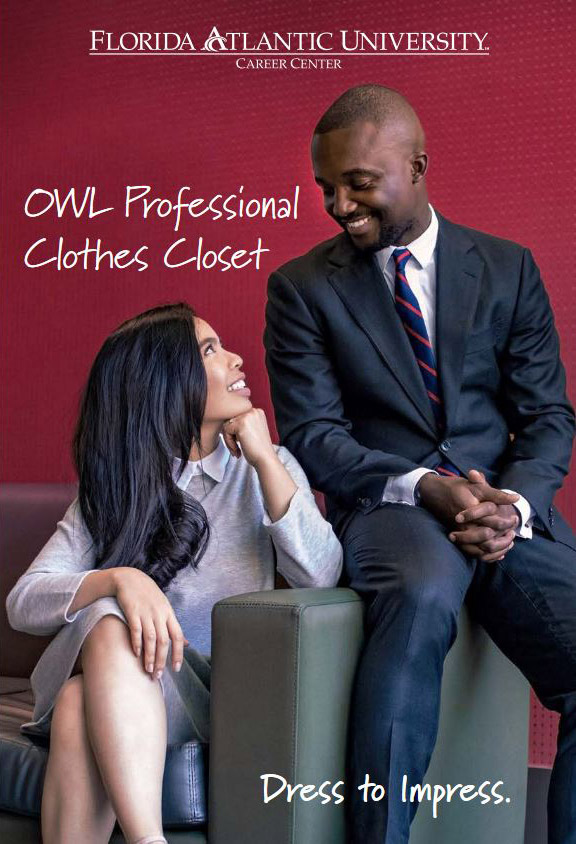
Download Clothes Closet Manual
How it works:
Update:
The closet will be temporarily unavailable during winter break, starting on Wednesday, December 10, and will reopen at the beginning of the Spring semester. We look forward to supporting you at the start of the new semester.
Donations:
Career Closet Donation Update:
Thank you for your continued support of the FAU Career Closet! We are temporarily pausing all clothing donations at this time.
We appreciate your generosity and understanding as we take this time to reorganize and prepare for future contributions. Please check back for updated donation guidelines.
Questions?
For more information or questions regarding the OWL Professional Clothes Closet, please contact the FAU Career Center at career@fau.edu.