ADAM SUSSER SCHOLARSHIP AWARD CRITERIA
Introduction:
Mr. Susser wants the award recipient to be someone “who embodies the qualities of a professional in the field.” The only other requirement stated was that the faculty and staff select the “most deserving student”.
In its preamble, the Code of Ethics of the American Speech-Language-Hearing Association describes the principles of ethics set forth in the code as essential for, “the preservation of the highest standards of integrity and ethical principles vital to the responsible discharge of obligations…”. The preamble further states that , “Principles of Ethics, aspirational and inspirational in nature, form the underlying moral basis for the Code of Ethics. Individuals shall observe these principles as affirmative obligations under all conditions of professional activity”. The ASHA Code of Ethics is presented to students during their new student orientation program.
This is the first contact that students have with the program and they are presented with the clear expectation that they will follow this code throughout their academic and professional lives. Given Mr. Susser’s charge, it was clear that the ASHA Code of Ethics must serve as the basis for the development of the award criteria.
The four Principles of Ethics stated in the ASHA Code of Ethics are as follows:
Principle of Ethics I:
Individuals shall honor their responsibility to hold paramount the welfare of persons they serve professionally or participants in research and scholarly activities and shall treat animals involved in research in a humane manner.
Principle of Ethics II:
Individuals shall honor their responsibility to achieve and maintain the highest level of professional competence.
Principle of Ethics III:
Individuals shall honor their responsibility to the public by promoting public understanding of the professions, by supporting the development of services designed to fulfill the unmet needs of the public, and by providing accurate information in all communications involving any aspect of the professions, including the dissemination of research findings and scholarly activities, and the promotion, marketing, and advertising of products and services.
Principle of Ethics IV:
Individuals shall honor their responsibilities to the professions and their relationships with colleagues, students, and members of other professions and disciplines.
American Speech-Language-Hearing Association. (2010r). Code of Ethics [Ethics].
Available from www.asha.org/policy.
Award Criteria:
Using Mr. Susser’s charge and the Code of Ethics from the American Speech-Language-Hearing Association, the following criteria were developed:
- The Student excels academically and clinically. (No specific GPA or grade requirement was attached to these two parameters).
- The Student is involved in all aspects of the field including, but not limited to, the areas of research, the National Student Speech-Language-Hearing Association, professional meetings, and department activities.
- The Student is ethical and professional during all activities related to the completion of his/her degree requirements.
- The Student is enthusiastic about the field of speech-language pathology.
- The Student “stands out” in the areas of communication (verbal and written), analysis and problem solving, integration of ideas and information, organization, and interpersonal skills.
- The Student is self-motivated and strives to be his/her best academically and clinically.
- The Student is responsible, trustworthy, and conscientious.
- The Student is mature, sensitive, perceptive, and responsive in dealing with individuals with speech, language, and hearing handicaps and their significant others.
- The Student works well with faculty and staff.
- The Student works well with peers and is viewed as a resource and exemplar.
- The Student exhibits the understanding to work with and within diverse groups with sensitivity, respect, and effectiveness recognizing that differences may exist in racial/ethnic history, language, attitudes/beliefs about disability, social values/customs, religious/spiritual beliefs and practices, health beliefs/practices, beliefs about sexuality/gender, and family structures/dynamics.
- The Student is viewed by faculty and staff as an individual who will continue to seek out knowledge and make a positive contribution to the profession.
APPLICATION INSTRUCTIONS
The application for College of Education scholarships is submitted through Scholarship Universe, and will be available early each fall semester.
Scholarship Universe is an online scholarship matching tool for students that makes finding and applying for both internal and external scholarships faster and easier. Internal scholarships refer to scholarships directly awarded by Florida Atlantic University, and external scholarships refer to any scholarships awarded by an outside source.
Scholarship Universe saves time with results best suited for students. Some opportunities require additional information such as reference letters or supporting documentation. Review FAU’s Scholarship Tips for best practices on applying.
Please note:
Meeting the minimum criteria does not guarantee a scholarship award. A current FAFSA must be on file with the Financial Aid office and must show unmet need for the semester for scholarships requiring financial need.
International Students:
The scholarships that indicate “financial need” as required in the criteria will require a FAFSA to be on file, so international students may need to consider their eligibility. International students are still encouraged to apply to merit-based scholarships that do not have a "financial need" requirement.
Recipient Selection:
If selected for a scholarship, students are notified via their FAU email. Students are responsible for checking their FAU emails and meeting deadlines to respond with a "thank you" letter to the donor. Failure to follow this procedure and adhere to the deadlines will result in forfeiting the scholarship.
Only students who receive scholarships will be notified.
Questions: Direct any questions to coescholarships@fau.edu
THE JOHN AND IRENE CRITELLI FAMILY SCHOLARSHIP FUND
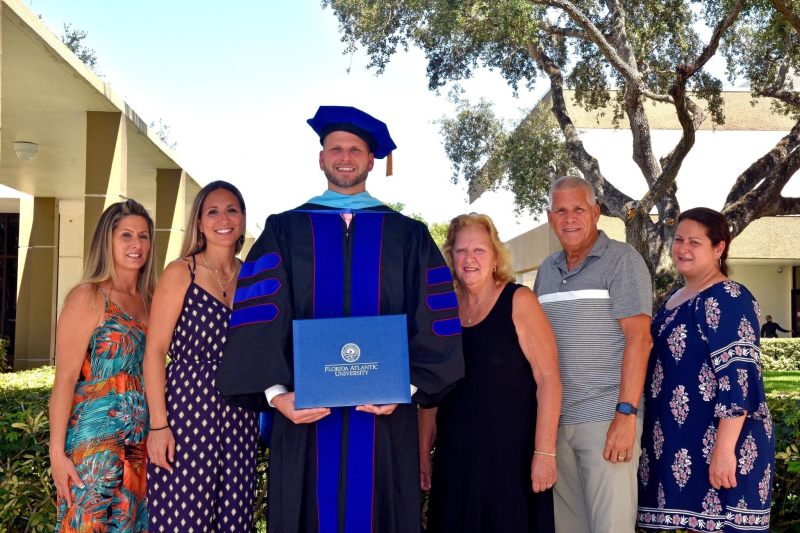
Supporting the next generation of school leaders who champion students with exceptional needs
The John and Irene Critelli Family Scholarship Fund was established through a generous endowment from the Critelli family to the Florida Atlantic University Foundation. The scholarship provides financial support to aspiring educational leaders enrolled in FAU’s School Leaders’ Partnership Programs developed in collaboration with Florida’s public-school districts. These programs are known for their rigor, local partnerships, and proven record of preparing highly effective school administrators.
Purpose
As the number of students with disabilities continues to rise, including those diagnosed with autism and other exceptionalities—our schools need leaders who understand not only instructional quality, but also the legal and ethical responsibilities of serving every child.
This fund invests in the preparation of those leaders. By providing scholarship support to educators pursuing leadership degrees with expertise or active roles in Exceptional Student Education (ESE), the scholarship helps ensure that children with special needs receive the services, advocacy, and compassion they deserve.
A Personal Connection
For the Critelli family, this scholarship carries deep personal meaning. Having experienced the challenges and triumphs of special education firsthand, the family understands how life-changing the right support can be for students, families, and educators alike. This endowment honors that experience while giving back to the community that helped shape their journey.
Vision for Growth
The fund will award one scholarship in the amount of $1,200 each Spring, with a long-term goal of expanding the endowment to support multiple scholars each year. The Critelli family envisions a growing legacy that continues to strengthen South Florida’s schools through well-prepared, compassionate leaders.