About Us
The labs current research focus areas include:
Imaging and Solid Modeling
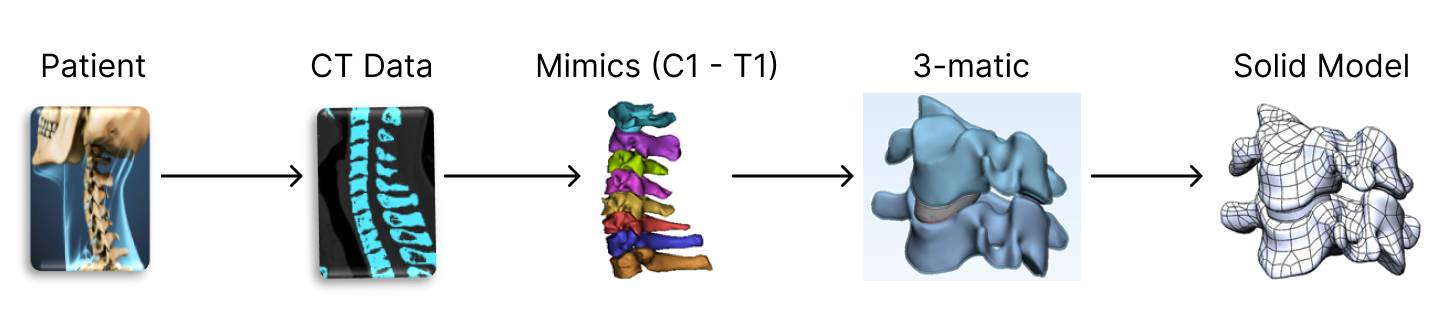
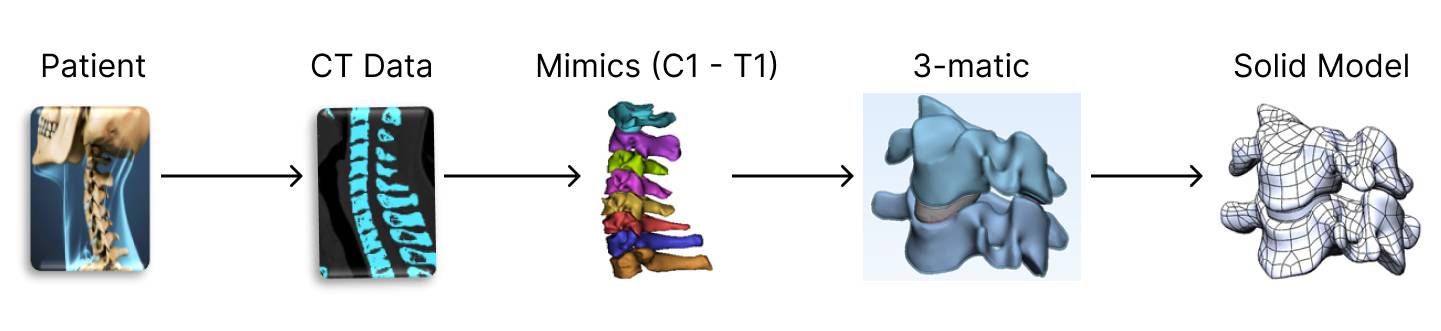
Based on patient’s MRI or CT scan anatomical images and Mimics software, the platform will rapidly create a 3D solid model of patient’s spine using the AI reconstruction system supported by an optimized physiological anatomical-based 3D convolutional neural network that can automatically achieve the computed tomography angiography reconstruction of spine.
Finite Element Biomechanics Simulation
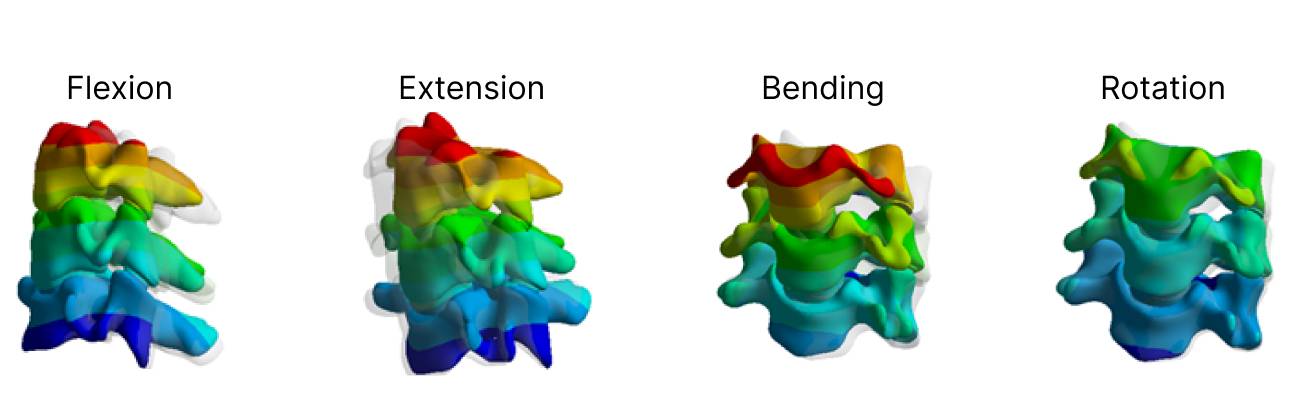
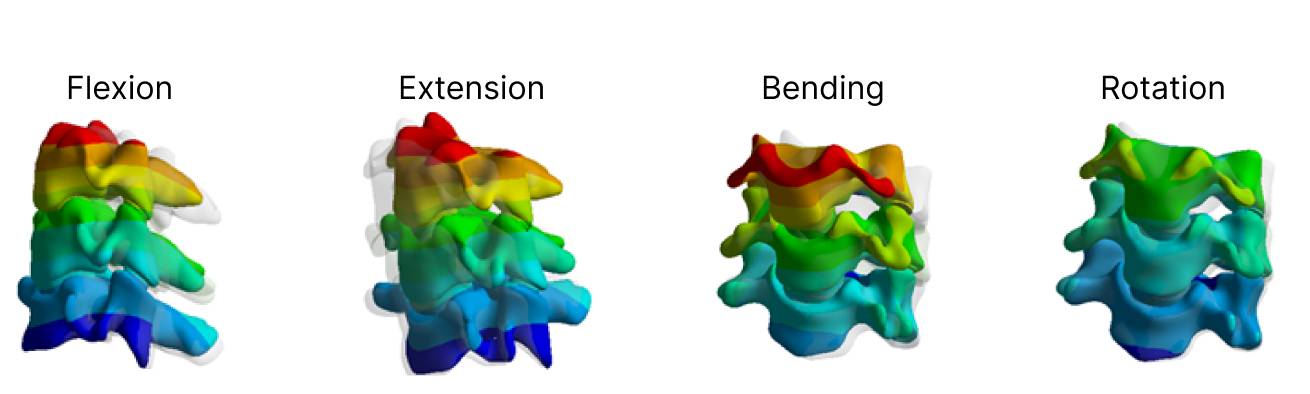
Finite element software such as Ansys and Abaqus will be used for the simulation. The typical process to build a validated, patient-specific finite element model of spine involves: (a) 3D solid model obtained from the MRI or CT scan, and the implant design obtained from 3D printer; (b) material properties and constitutive model for the implant and each spine components such as vertebrae, ligaments, intervertebral disc, facet joints and muscles, etc.; (c) definition of boundary conditions, loads, constraints, and contact conditions; (d) mesh generation, convergent test, validation and sensitivity analysis; (e) develop dependable model of cadaver specimens to establish the error bounds for patient-specific model validation.
Spinal Implants Design/Analysis and 3D printing
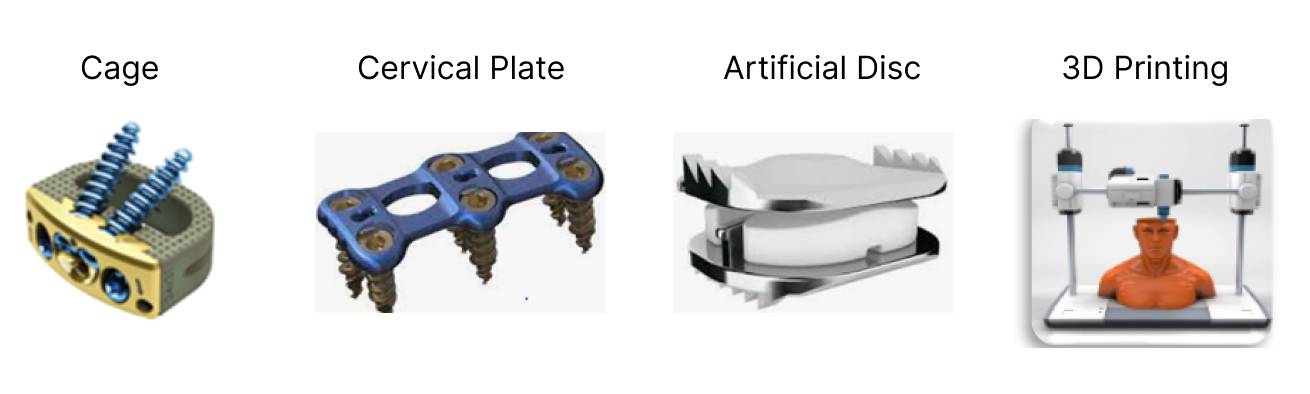
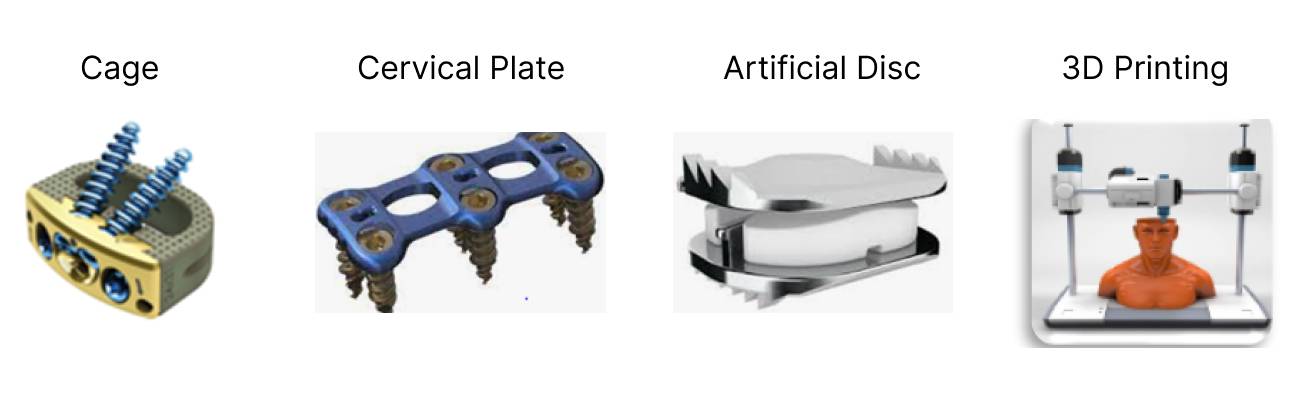
Finite element software such as Ansys and Abaqus will be used for the simulation. The typical process to build a validated, patient-specific finite element model of spine involves: (a) 3D solid model obtained from the MRI or CT scan, and the implant design obtained from 3D printer; (b) material properties and constitutive model for the implant and each spine components such as vertebrae, ligaments, intervertebral disc, facet joints and muscles, etc.; (c) definition of boundary conditions, loads, constraints, and contact conditions; (d) mesh generation, convergent test, validation and sensitivity analysis; (e) develop dependable model of cadaver specimens to establish the error bounds for patient-specific model validation. A 3D printed Cadaver will be developed and sensitized with various developed biosensors. The cadaver model will be validated using values of literature and the intact model of the same spine. The biosensors will be validated using the FEA model.
Patient Spine Monitoring App
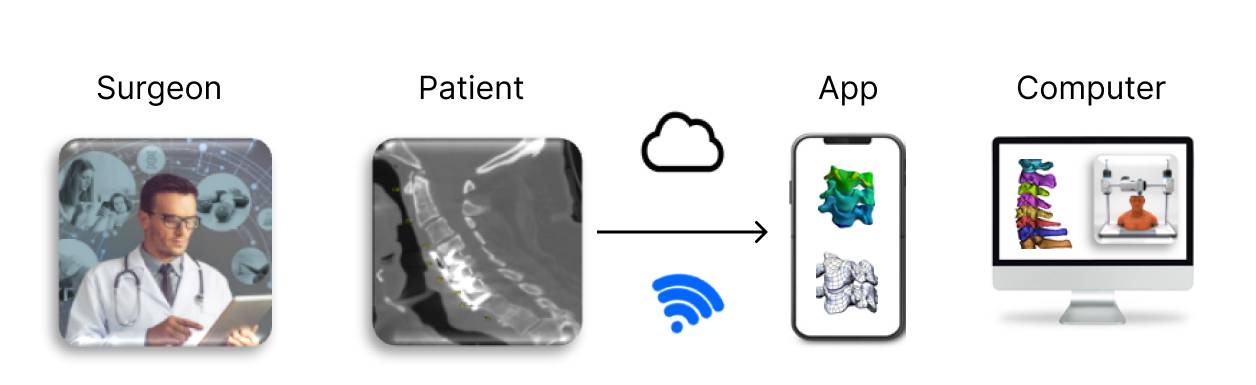
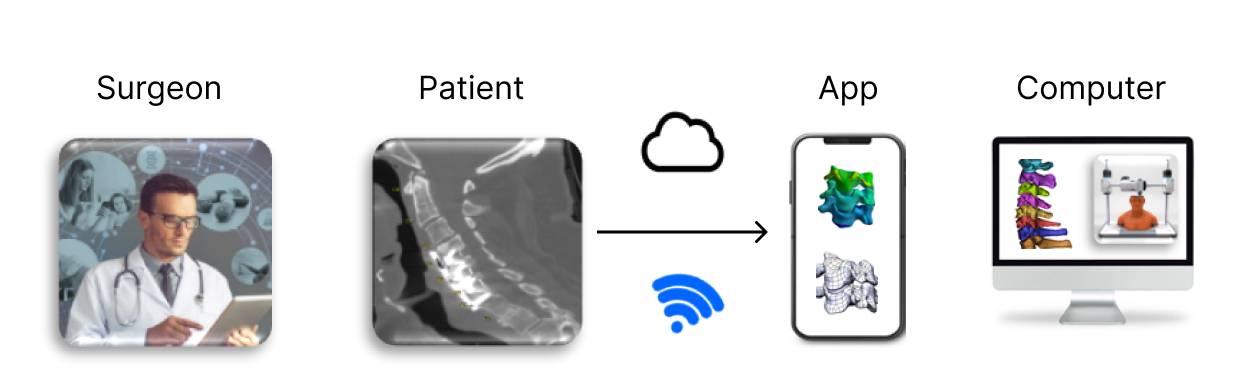
Micro biosensors will be developed and implanted in the cadaver to measure the stress/force and range of motion in the spine, and the subsidence and micromotion of the implants such as cage and artificial disc. The produced and tested biosensors will be implanted into cervical instrumentation for retrieval of in vivo information that will be sent to an app accessed by the patients and clinical team for post-operative follow up. The data will also be uploaded to a cloud data base that will serve as the standard of validation for future developed FEA. These FEA will then be used to improve the next generation of biosensors and so on until both simulation methodologies and biosensing capabilities are perfected.
Research
Spine Research Publications
- Dhar, U.K., Menzer, E.L., Lin, M., Hagerty, V., O’Connor, T., Tsai, C.T. and Vrionis, F.D., 2023. Factors influencing cage subsidence in anterior cervical corpectomy and discectomy: a systematic review. European Spine Journal, 32(3), pp.957-968. https://doi.org/10.1007/s00586-023-07530-w. (I.F.2.8)
- Doulgeris, J., Lin, M., Lee, W., Aghayev, K., Papanastassiou, I.D., Tsai, C.T. and Vrionis, F.D., 2024. Inter-Specimen Analysis of Diverse Finite Element Models of the Lumbar Spine. Bioengineering, 11(1). https://doi.org/10.3390%2Fbioengineering11010024. (I.F. 4.6)
- Kamran, A., Kanti, D.U., Chi-Tay, T. and Merdin, A., 2024. Sacrolumbar Interbody Fusion (SLIF): Feasibility, Technical Nuances, Biomechanical Assessment, And Clinical Outcomes. Spine Surgery and Related Research. https://doi.org/10.22603/ssrr.2023-0240. (I.F.1.2)
- Lin, M.; Shapiro, S.Z.; Erik D.; Tsai, C.T.; Vrionis, F.D. Finite element analysis of the effect of anterior dynamic plating on two-level anterior cervical discectomy fusion biomechanics. World Neurosurgery 2022. https://doi.org/10.1016/j.wneu.2022.02.032. (IF:2.104)
- Lin, M.; Paul, R.; Shapiro, S.Z.; Doulgeris, J.; Tsai, C.T.; Vrionis, F.D. Biomechanical study of cervical endplate removal on subsidence and migration in multi-level anterior cervical discectomy and fusion. Asian Spine Journal 2022. https://doi.org/10.31616/asj.2021.0424. (IF:2.022)
- Lin, M.; Abd, M.A.; Taking, A.; Tsai, C.T.; Vrionis, F.D. Engeberg, E.D. Robotic replica of a human spine uses soft magnetic sensor array to forecast intervertebral loads and posture after surgery. Sensors 2022, 22, 212. https://doi.org/10.3390/s22010212. (IF: 3.576)
This paper was reported in multiple famous website and news.
Most Notable Article in Sensors and Robotics Topic Area, January-February, 2022. - Lin, M.; Shapiro, S.Z.; Doulgeris, J.; Engeberg, E.D.; Tsai, C.T.; Vrionis, F.D. Cage-screw and anterior plating combination reduces the risk of micromotion and subsidence in multilevel anterior cervical discectomy and fusion—a finite element study. The Spine Journal 2021, 21, 874-882. https://doi.org/10.1016/j.spinee.2021.01.015. (IF:4.166)
- Lin, M., Paul, R., Dhar, U.K., Doulgeris, J., O'Connor, T.E., Tsai, C.T. and Vrionis, F.D., 2023. A Review of Finite Element Modeling for Anterior Cervical Discectomy and Fusion. Asian Spine Journal, 17(5). https://doi.org/10.31616/asj.2022.0295. (I.F. 2.3)
- Lin, M., Doulgeris, J., Dhar, U.K., O’Corner, T., Papanastassiou, I.D., Tsai, C.T. and Vrionis, F.D., 2023. Effect of graded posterior element and ligament removal on annulus stress and segmental stability in lumbar spine stenosis: A finite element analysis study. Frontiers in Bioengineering and Biotechnology, 11. https://doi.org/10.3389/fbioe.2023.1237702 (I.F. 6.7)
- Lin M, Paul R, Liao X, Doulgeris J, Menzer EL, Dhar UK, Tsai C-T, Vrionis FD. A New Method to Evaluate Pressure Distribution Using a 3D-Printed C2-C3 Cervical Spine Model with an Embedded Sensor Array. Sensors. 2023; 23(23):9547. https://doi.org/10.3390/s23239547. (I.F. 3.9)
Funding
- Spine finite element modeling (Boca Raton Reginal Hospital, Grant No. SP 19-579)
Media Press Release
-
“Pain in the Neck? New Surgical Method Could be Game-changing” published in:
/newsdesk/articles/neck-surgery-new-technology.php
https://www.newswise.com/articles/pain-in-the-neck-new-surgical-method-could-be-game-changing -
“3D-Printed Spine Replica and Soft Magnetic Sensor Array Enable Surgeons to Preview the Effects of Surgery” published in:
https://www.azosensors.com/news.aspx?newsID=14890 -
“Novel robotic replica of human spine enables surgeons to preview the effects of surgery” published in:
https://www.news-medical.net/news/20220119/Novel-robotic-replica-of-human-spine-enables-surgeons-to-preview-the-effects-of-surgery.aspx
People

Lab Director
Chi-Tay Tsai, Ph.D.
Professor Department of Ocean & Mechanical Engineering tsaict@fau.edu 561.297.2824
Research Interests
- Spine biomechanics
- Finite element modeling
- Computational mechanics and materials
- Dislocation dynamics of semiconductor crystals
- Laminated plates and shells
- Structural stability
Spine Biomechanics Lab
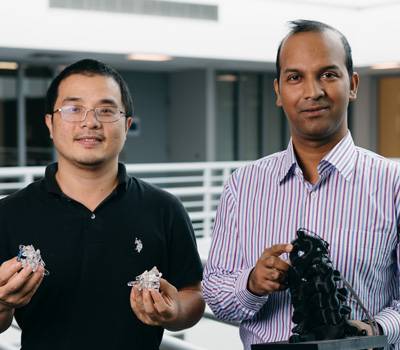
The Spine Biomechanics Lab at FAU focus on the physics-informed data-driven spine modeling for next generation smart neurosurgery. By integrating the advanced image process, AI technology/machine learning, finite element simulation, biosensors, and 3D printing, a patient-specific spine model can be created for clinical practice. Our research goal is to improve neurosurgery, providing patients with (1) minimum incision for quick recovering, (2) less surgery time for reducing the risk of complications and health care cost, (3) patient-specific implant will ensure a better implant compatibility for reducing the failure rate of the implant and increase the durability of the implant. Our research can also help engineers, scientists, and clinicians to develop new technologies for prevention of spine injuries and for the design of rehabilitative, therapeutic, and surgical intervention to treat spine diseases.